Project Orion: Nuclear Bomb Starship That Almost Was
Project Orion: Nuclear Bomb Starship That Almost Was
Europa Clipper Radiation Vault: Surviving Jupiter
VASIMR Plasma Engine: Could It Transform Mars Travel?
Iapetus Equatorial Ridge: The Solar System's Strangest Mountain

Titan's Hidden Ocean: Ammonia Keeps Water Liquid

Mimas: How Saturn's Death Star Moon Hides an Ocean
TL;DR: Circumbinary planets - worlds orbiting two stars - defy early theories that predicted chaos would prevent their formation. Dozens have been confirmed, revealing a narrow stability zone just beyond where binary perturbations destroy orbits, rewriting planetary science.
Ten years ago, astronomers confirmed something that seemed pure fantasy - planets orbiting not one star, but two. These circumbinary worlds shouldn't exist according to early planetary formation models, yet here they are: dozens of confirmed examples defying conventional wisdom about how solar systems form and survive.
The discovery reshapes our understanding of planetary diversity and forces a fundamental question: if planets can orbit binary stars despite chaotic gravitational forces, what other "impossible" worlds might exist?

When a planet orbits two stars, it enters a gravitational nightmare. Unlike the stable, predictable dance between Earth and the Sun, a circumbinary planet navigates constant interference from two massive bodies pulling in different directions.
This creates what mathematicians call the three-body problem - a system with no general solution. While two objects orbiting each other follow elegant, predictable paths, adding a third body introduces chaos. The resulting dynamics are so complex that even supercomputers can only approximate trajectories through brute-force calculation.
The restricted three-body problem models this scenario: two massive stars revolve around their shared center of mass while a much smaller planet moves through their combined gravitational field. The Jacobi integral represents the only conserved quantity in this system, meaning there's no mathematical formula to guarantee long-term stability.
Most initial configurations lead to disaster. Numerical simulations show that planetary orbits within a few stellar separation distances become chaotic, ending in ejection into interstellar space or collision with one of the stars.
Yet circumbinary planets not only exist - they thrive in a narrow stability zone that reveals profound insights about orbital mechanics.
The three-body problem has no general closed-form solution. When three bodies orbit each other, the resulting dynamical system is chaotic for most initial conditions - yet circumbinary planets have found a way to survive in stable zones.
Every circumbinary system has an invisible boundary. Inside this critical radius, gravitational perturbations from the binary tear orbits apart. Outside it, planets can survive for billions of years.
Research shows this stability threshold sits at roughly two to four times the binary separation distance. If the two stars orbit 0.5 AU apart, planets beyond about 1 - 2 AU have a fighting chance.
What's remarkable is how tightly planets cluster just beyond this limit. Nearly every known circumbinary planet orbits within 20% of its system's critical radius, implying that planetary migration - the gradual drift of forming planets through their birth disk - stops precisely where binary perturbations become too violent.
This pattern wasn't predicted by early theories. It suggests that circumbinary disk dynamics create a natural parking zone where migrating planets halt, unable to spiral closer without destabilizing.
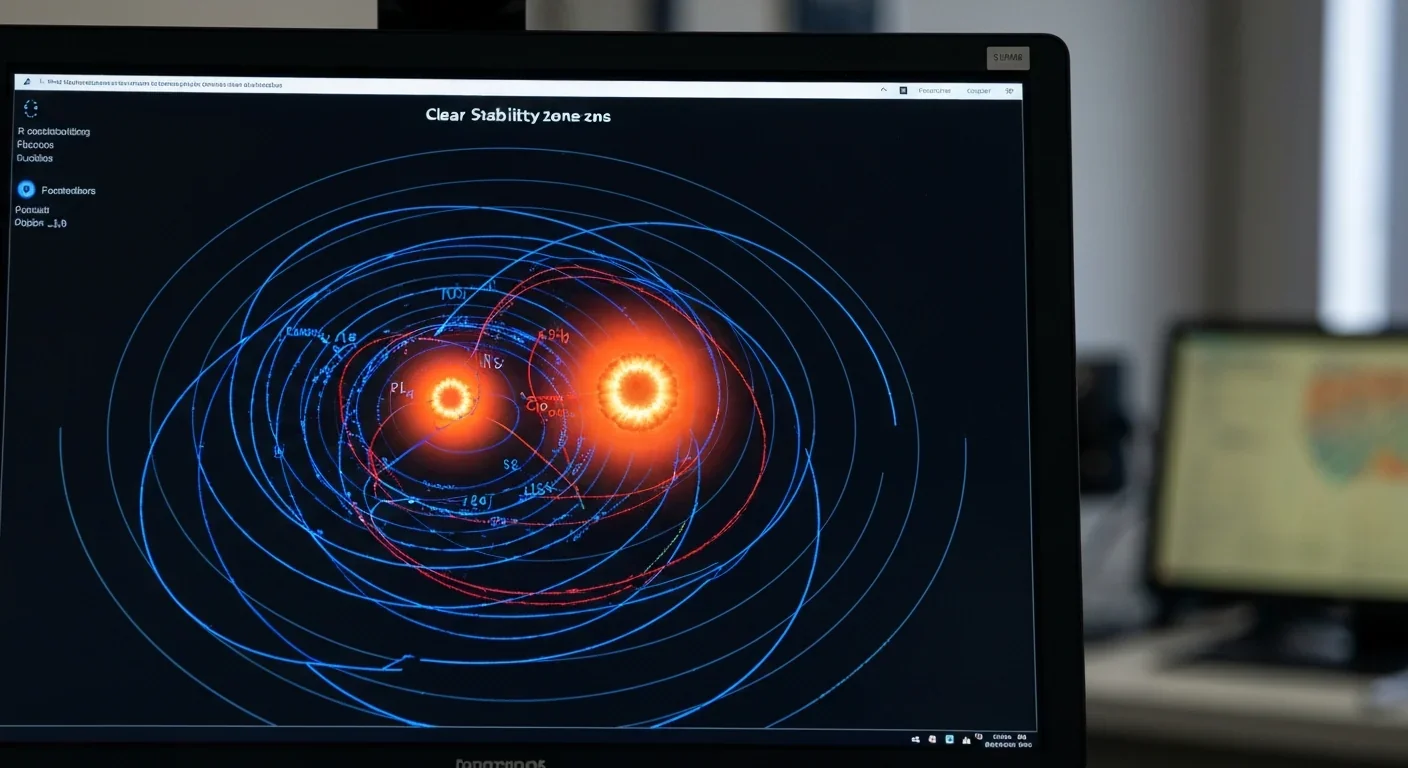
The Kepler-47 system illustrates this beautifully. Its two stars orbit every 7.45 days - an exceptionally tight binary. Yet three planets orbit safely at distances of 0.30, 0.99, and 0.70 AU from the binary's center of mass, all positioned just beyond the danger zone.
Kepler-47d, the middle planet discovered in 2019, surprised researchers by being the largest of the trio at seven Earth radii, despite lying between two smaller worlds. Jerome Orosz, the lead astronomer, said they saw hints of this planet in 2012 but needed years of additional data to confirm its existence because its transit signal varied so dramatically over time.
"We saw a hint of a third planet back in 2012, but with only one transit we needed more data to be sure. We certainly didn't expect it to be the largest planet in the system. This was almost shocking."
- Jerome A. Orosz, San Diego State University
How do planets form when their birth environment is being constantly shaken by two stars? The standard model of planetary formation - slow accumulation of dust and ice into progressively larger bodies - struggles to work in such chaos.
Two competing theories have emerged.
Core accretion remains the favored explanation for most planetary systems. In this scenario, solid particles in the circumbinary disk gradually collide and stick together, building up planetesimals, then planetary cores, and finally massive gas giants if the core grows large enough to capture surrounding hydrogen and helium before the disk dissipates.
But binary perturbations make this process harder. The disk gets heated and stirred by gravitational torques from the orbiting stars, increasing collision velocities between particles so they shatter instead of merging. Formation models suggest that only in the outer, quieter regions of circumbinary disks can core accretion proceed successfully.
Disk instability offers an alternative. If a massive disk becomes gravitationally unstable, it can fragment directly into planet-sized clumps within a few orbital periods - fast enough that binary perturbations don't have time to disrupt the process.
Some evidence supports this rapid formation pathway. The fact that most Kepler circumbinary planets are smaller than Jupiter contradicts what you'd expect from pure observation bias, since larger planets produce stronger transit signals and should be easier to detect. If disk instability were the dominant formation mechanism, we'd expect more massive gas giants.
Instead, the population suggests that smaller planets form via core accretion far from the binary, then migrate inward until binary perturbations halt their progress at the critical radius.
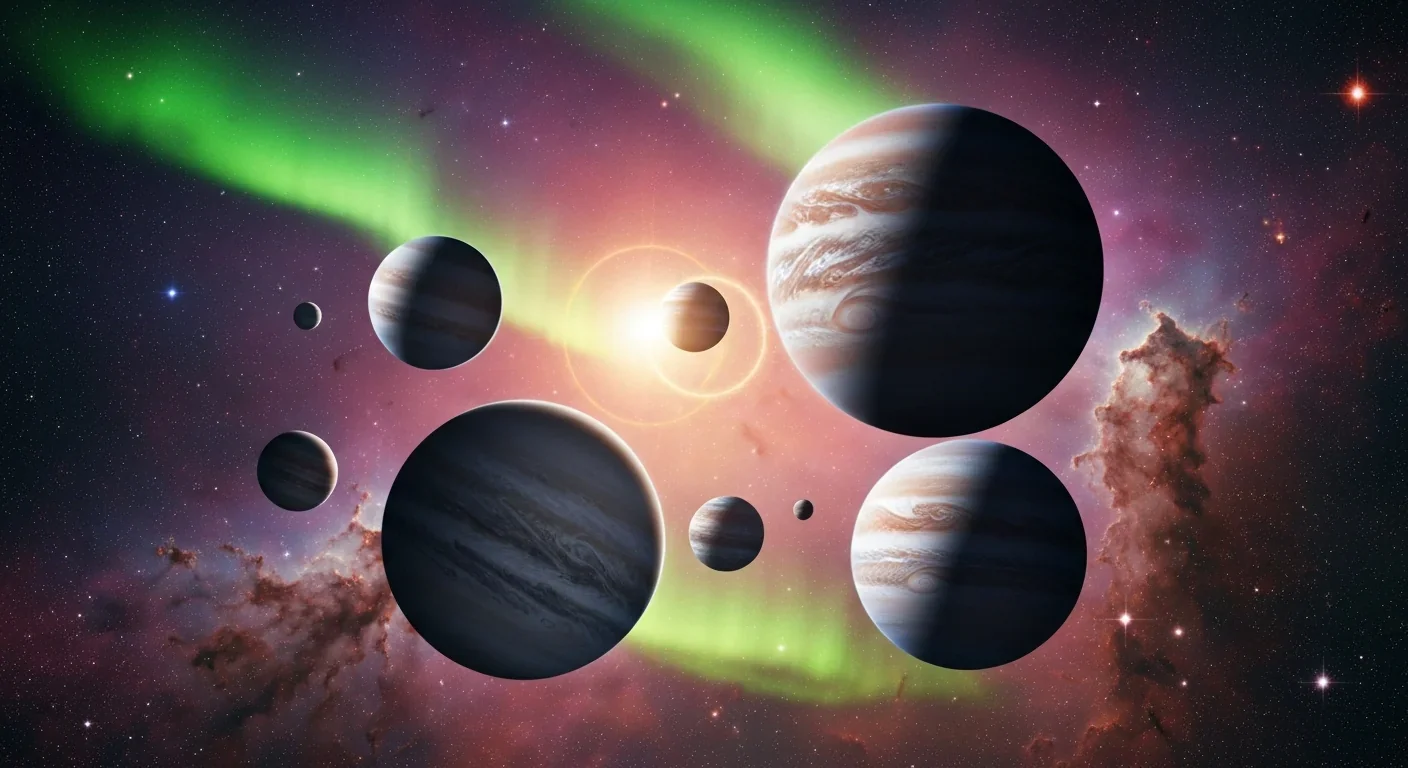
A study of the BEBOP-4 system complicates this picture. This system contains a brown dwarf - an object 13 to 15 times Jupiter's mass - on an eccentric orbit with a period near 1,900 days. Its orbit lies precariously between two destabilizing secular resonances, yet the system remains stable.
Researchers propose that BEBOP-4b formed through disk fragmentation farther out, then migrated inward, its eccentricity damped by interactions with remaining disk material. The alternative - core accretion at such a large distance - would take too long, allowing disk dispersal before a massive core could form.
Discovering circumbinary planets requires patience and precision beyond typical exoplanet searches.
The transit method - watching for the dimming when a planet crosses in front of its star - works differently for circumbinary worlds. Because both stars and the planet are all moving in complex ways, transits don't repeat on a regular schedule.
Kepler-47d's discovery illustrates this challenge. When Kepler first observed the system, the planet's orbital plane had shifted slightly, making its transits too shallow to detect with confidence. Over four years, the planet's orbit precessed - its orientation slowly rotating - bringing it into better alignment with our line of sight. The transit depth grew from undetectable to the deepest of the three planets.
This orbital precession results from the gravitational influence of the binary on the planet's orbit. While single-star planets maintain fixed orbital planes for billions of years, circumbinary planets experience torques that cause their orbits to wobble, creating time-variable transit signals.
For TOI-1338 b, TESS (Transiting Exoplanet Survey Satellite) captured the closest-ever image of a circumbinary planet. This gas giant, 6.9 times Earth's radius, orbits two stars every 0.6 days at just 0.11 AU - remarkably close for a stable circumbinary orbit.
Circumbinary planets violate the assumption that transits repeat on regular schedules. Their orbital planes shift over time due to binary perturbations, making transit depth and timing highly variable across years.
The BEBOP survey takes a different approach, using radial velocity measurements instead of transits. By tracking how stars wobble due to an orbiting planet's gravity, astronomers can infer the planet's mass and orbit even when it doesn't transit.
BEBOP-4b was discovered through 84 high-resolution spectra collected over six years, revealing a long-period wobble induced by the distant brown dwarf. Future Gaia astrometry observations - which measure precise stellar positions - will confirm the companion's true mass and orbital inclination, breaking the degeneracy inherent in radial velocity measurements.
Looking ahead, researchers have identified nearly 600 edge-on binary star systems using data from the European Space Agency's Gaia catalog. Because these systems align with our line of sight, both stars and any planets wobble directly toward and away from Earth, amplifying detection signals.
This catalog essentially provides a treasure map for planet hunters, predicting where circumbinary worlds are most likely to be found and characterized.
Imagine standing on a circumbinary planet. As your world orbits its binary stars, you'd witness two sunrises and two sunsets per orbit - but not on a predictable schedule.
The variable illumination creates climate challenges unknown in single-star systems. As the two stars orbit each other, their relative positions constantly change. Sometimes they appear close together in your sky, combining their light. Sometimes they're on opposite horizons, extending your "day" significantly.
This produces seasonal variations unrelated to axial tilt. A circumbinary Earth might experience dramatic temperature swings tied to the binary orbital period rather than yearly seasons.
For habitability, atmospheric composition becomes critical. Moderate amounts of greenhouse gases like carbon dioxide and methane could buffer temperature fluctuations, maintaining temperate conditions despite variable insolation. But excessive greenhouse forcing risks a runaway effect, turning a habitable world into a Venus-like furnace.
Kepler-47c, orbiting in what researchers call the "habitable zone" - the distance where liquid water could exist - has an equilibrium temperature around -5°C. For comparison, Kepler-47d sits at roughly 10°C, while the innermost planet, Kepler-47b, bakes at 169°C.
These temperatures assume no atmospheric greenhouse effect. An Earth-like atmosphere could warm Kepler-47c enough for surface water, making it a potential target for future biosignature searches.
But habitability faces another complication: orbital instability over deep time. While circumbinary planets can remain stable for millions or billions of years, they occupy a narrower stability range than single-star worlds. Gradual orbital evolution due to tidal forces or distant stellar companions could eventually push a planet past the stability threshold.
"In such systems, the companion star can serve as a stabilizer for the planets' orbits, preventing dramatic long-term climate variations that may otherwise be destructive to life as we know it."
- Malena Rice, Yale University
Paradoxically, some research suggests the binary companion might actually stabilize planetary orbits against long-term climate variations. Malena Rice, lead author of a study on edge-on binaries, notes that the companion star can prevent dramatic long-term climate variations that may otherwise be destructive to life.
This stabilization effect could make some circumbinary worlds more clement than their single-star counterparts, expanding the galactic real estate suitable for life.
When Kepler began its mission, circumbinary planets were theoretical curiosities. Now they're an established planetary class.
Kepler discovered 14 circumbinary planets via the transit method. TESS added more. Three additional systems have been confirmed through radial velocity observations, including the BEBOP discoveries.

Approximately 10% of all star systems observed by Kepler host circumbinary planets - a surprisingly high fraction suggesting these worlds aren't rare anomalies but a significant component of galactic planetary diversity.
Nearly all detected circumbinary planets are Neptune-to-Jupiter-sized gas giants. This doesn't necessarily reflect the true population. Smaller planets produce weaker transit signals, making them harder to detect. But it also suggests possible physical limits.
One intriguing pattern: Kepler circumbinary planets show a size limit below which they cluster. Most are smaller than Jupiter despite Jupiter-mass planets being easier to detect. This hints that large gas giants may struggle to survive close-in circumbinary orbits during formation, either because binary perturbations eject them or prevent them from migrating to their current positions.
The first confirmed circumbinary planet, PSR B1620-26 b, remains an outlier. Discovered in 1993 and confirmed in 2003, this Jupiter-mass world orbits a pulsar-white dwarf binary at 23 AU with very low eccentricity - a dramatically different environment from the main-sequence binaries Kepler studied.
Its existence proves circumbinary planets can form around diverse stellar types and survive even the violent supernova that created its pulsar host.
The three-body problem that governs circumbinary dynamics also predicts exotic configurations.
Lagrange points - positions where gravitational forces and orbital motion balance - exist even in binary star systems. The L4 and L5 points, located 60 degrees ahead of and behind a planet in its orbit, offer stable parking spots for smaller bodies.
Could Trojan planets exist at these points in circumbinary systems? Simulations suggest yes, though none have been detected yet. Finding one would open a new chapter in planetary system architecture.
Mean-motion resonances - where orbital periods form simple ratios like 2:1 or 3:2 - also appear in circumbinary systems. These resonances can stabilize orbits that would otherwise be chaotic, allowing planets to survive closer to their binary than the standard critical radius suggests.
Some circumbinary planets show hints of resonant configurations with their binaries, like 5:1 period ratios. Understanding how these resonances form and how common they are would illuminate the migration histories of circumbinary worlds and refine our stability models.
The existence and properties of circumbinary planets force revisions across planetary astrophysics.
Formation theory must now account for planetary assembly in dynamic, hostile environments. The narrow pile-up of planets just beyond the critical radius constrains migration models and disk physics in ways single-star systems cannot.
Orbital dynamics research gains a natural laboratory for three-body interactions. Each circumbinary planet provides a test case for theories of long-term stability, resonance capture, and chaotic evolution.
Habitability studies expand their scope. Dr. Elisa Quintana of NASA's Goddard Space Flight Center notes that "the discovery of TOI-1338 b and similar planets forces us to rethink our assumptions about where life might exist. We need to broaden our search parameters and consider environments that were previously deemed too hostile."
This philosophy shift has practical implications. Future missions like the Habitable Worlds Observatory must include circumbinary habitable zones in their target selection, despite the observational challenges these systems present.
Detection methods evolve to handle time-variable signals. Standard transit-search algorithms assume periodic transits; circumbinary planets violate this assumption. New techniques that can identify transits with variable timing and depth are essential for finding smaller circumbinary worlds.
About 10% of binary star systems observed by Kepler host circumbinary planets - suggesting billions of twin-sun worlds exist across the galaxy, each a laboratory for extreme planetary science.
Several technological advances will revolutionize circumbinary planet science over the next decade.
Gaia DR4, the European Space Agency's upcoming astrometry release, will provide unprecedented positional accuracy for nearby stars. The BEBOP-4 system will have a signal-to-noise ratio of 555 for its brown dwarf companion, making it the only circumbinary planet currently detectable with Gaia's single-epoch measurements.
These astrometric data will determine true masses and mutual inclinations, breaking the mass-inclination degeneracy inherent in radial velocity discoveries and allowing direct tests of formation scenarios.
JWST observations are beginning to characterize circumbinary planet atmospheres. Transmission spectroscopy during transits can reveal atmospheric composition, temperature structure, and cloud properties - information crucial for understanding how these worlds regulate their climates despite variable stellar irradiation.
Next-generation ground-based telescopes - the Extremely Large Telescope, Thirty Meter Telescope, and Giant Magellan Telescope - will push direct imaging to smaller separations and lower masses, potentially imaging circumbinary planets directly rather than inferring them from transits or radial velocities.
Refined numerical simulations incorporating realistic disk physics, magnetic fields, and radiative transfer will test whether circumbinary formation scenarios can reproduce the observed population. These models must explain not just individual systems but the statistical properties: size distributions, eccentricity patterns, and the tight clustering near the critical radius.
Forty years ago, planetary science was built on a sample size of one: our solar system. Planets were rocky or gaseous, orbited a single star, and formed in orderly fashion from a tranquil disk.
Every decade since has demolished these assumptions. We've found hot Jupiters impossibly close to their stars, super-Earths in a size range absent from our system, planets around pulsars and white dwarfs, and now worlds bathed in light from two suns.
Circumbinary planets represent more than an exotic curiosity. They demonstrate that planet formation is robust - so flexible that it works even in chaotic, disrupted environments that should prevent it. They show that stable orbits exist in parameter spaces once considered forbidden. They expand the galactic habitable zone to include configurations once dismissed as uninhabitable.
About 10% of stars in binary systems might host planets. Given that roughly half of all Sun-like stars are in binary or multiple systems, circumbinary worlds could represent a substantial fraction - perhaps 5% - of all exoplanets in our galaxy.
That's billions of worlds under two suns, each a laboratory for extreme planetary science and a potential home for life that evolved under conditions utterly foreign to Earth.
The real Tatooine-like worlds turn out to be more than science fiction. They're a reminder that the universe's creativity far exceeds our imagination - and that the most important discoveries often come from phenomena we initially thought impossible.
As we continue surveying the galaxy with ever-more-sensitive instruments, we'll find more of these exotic systems, each revealing new facets of how planets form, survive, and evolve in configurations we're only beginning to understand.
The twin-sun worlds are no longer fantasy. They're real, they're diverse, and they're rewriting the rules of planetary science.
Project Orion was a real 1960s program to reach other stars by detonating 800 nuclear bombs behind a spacecraft. The physics worked and the engineering was feasible, but the 1963 nuclear test ban treaty killed it. It remains the most credible interstellar spacecraft ever designed.

The locus coeruleus, a tiny brainstem structure, degenerates decades before Alzheimer's symptoms appear. Its loss cripples the brain's inflammation control, waste clearance, and sleep regulation. New imaging tools and noradrenergic therapies offer hope for early detection and prevention.

Research shows the sharing economy often increases total resource consumption through the Jevons paradox and rebound effects. Ride-sharing adds billions of vehicle miles, co-working spaces use more energy per worker, and diffused responsibility erodes conservation behavior. Breaking the paradox requires congestion pricing, accountability design, and matching sharing models to appropriate resource types.

Psychological reactance theory explains why banning or restricting things makes people want them more. From Prohibition to the Streisand effect to scarcity marketing, research shows that threatening people's freedom reliably backfires, and autonomy-supportive communication is far more effective.

A carnivorous pitcher plant in Borneo evolved to house bats instead of trapping insects, gaining up to 95% of its nitrogen from bat guano. The plant even built an ultrasonic reflector to help bats find it, revealing that carnivory in plants is a flexible spectrum.

The quantified self movement began as a hacker-ethos pursuit of personal insight, but corporate wearables now funnel biometric data to employers, insurers, and data brokers. With 81% of Americans wrongly believing health apps are HIPAA-protected, a regulatory void enables health data to be sold for pennies while generating anxiety instead of empowerment.

CXL memory pooling lets servers dynamically share DRAM over a cache-coherent interconnect, eliminating the 40% stranded memory waste in data centers. With commercial hardware now shipping and Azure deploying CXL cloud instances, this technology promises to cut memory costs by 50% while enabling composable infrastructure.

Loading featured articles...