Project Orion: Nuclear Bomb Starship That Almost Was
Project Orion: Nuclear Bomb Starship That Almost Was
Europa Clipper Radiation Vault: Surviving Jupiter
VASIMR Plasma Engine: Could It Transform Mars Travel?

Iapetus Equatorial Ridge: The Solar System's Strangest Mountain

Titan's Hidden Ocean: Ammonia Keeps Water Liquid

Mimas: How Saturn's Death Star Moon Hides an Ocean
TL;DR: Magnetars are neutron stars with the strongest magnetic fields in the universe, reaching quadrillion gauss. These cosmic monsters emit spectacular X-ray and gamma-ray bursts from crustal fractures, may produce fast radio bursts, and serve as natural physics laboratories testing quantum theory at impossible extremes.
Imagine a magnetic field so powerful it could erase your credit cards from halfway across the solar system. Now multiply that a billion times over. That's a magnetar: the universe's undisputed magnetic champion, where the laws of physics get pushed to their absolute breaking point and sometimes create fireworks we can detect from across the galaxy.
These aren't your everyday neutron stars. While a typical neutron star packs a sun's worth of mass into a sphere the size of Manhattan, magnetars take this extremity one step further. Their magnetic fields reach a quadrillion gauss (10^15 G), thousands of times stronger than their neutron star cousins. To put that in perspective, the strongest continuous magnetic field ever produced on Earth barely scratches 45 tesla, about 450,000 gauss. A magnetar could literally tear atoms apart at distances of thousands of kilometers.
But what makes these cosmic monsters truly spectacular isn't just their strength. It's what happens when all that magnetic energy decides to let loose.
The story of a magnetar begins with catastrophe. When a massive star, at least 10-25 times the mass of our Sun, exhausts its nuclear fuel, its core collapses in milliseconds. The resulting supernova explosion is one of the most violent events in the cosmos, briefly outshining entire galaxies. But for certain stars, this is just the opening act.
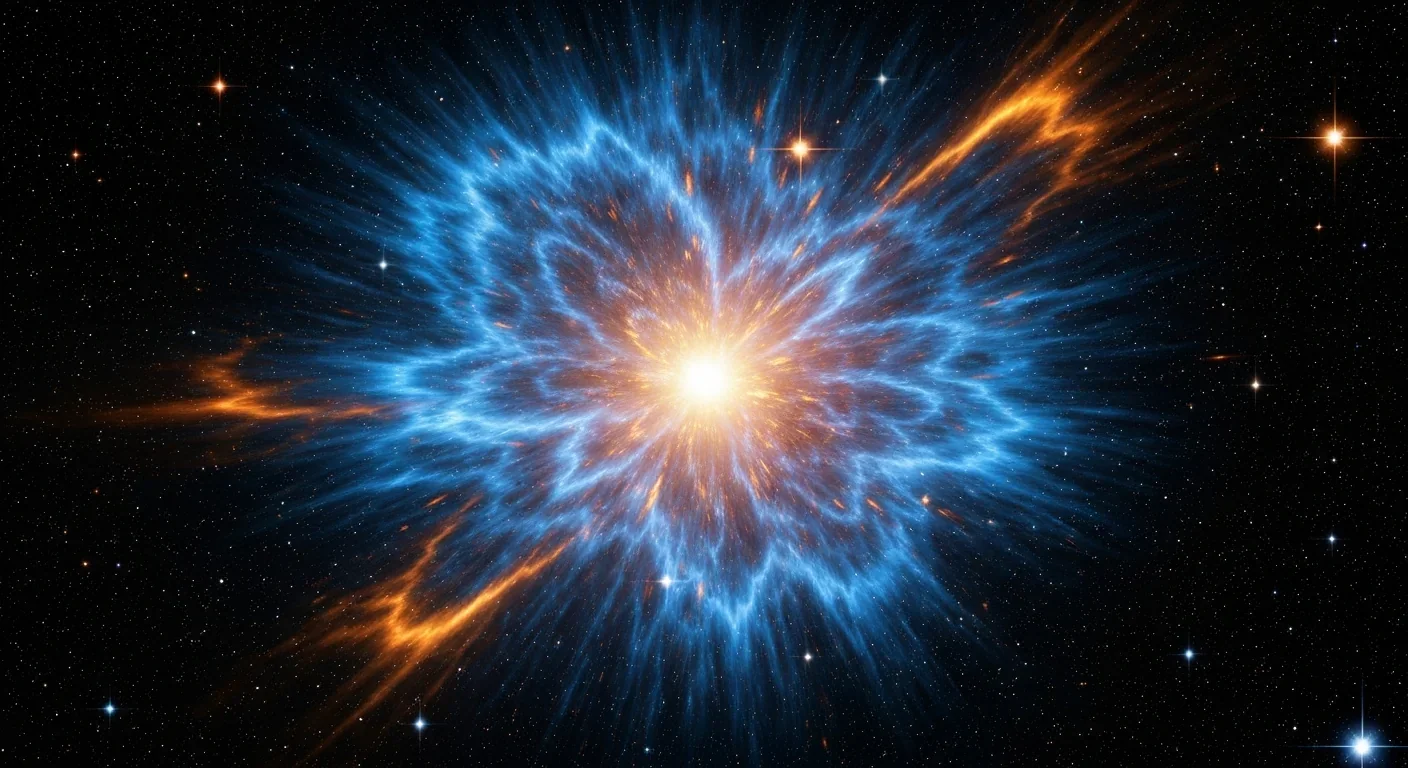
In the chaos of collapse, something extraordinary happens. The star's magnetic field gets amplified through what physicists call the dynamo effect. Think of it like a cosmic blender where rotation, convection, and collapsing matter create a self-reinforcing magnetic feedback loop. Within seconds, a magnetic field that might have started at "merely" a trillion gauss amplifies to quadrillion-gauss levels.
Magnetar magnetic fields reach 10^15 gauss - so powerful they could distort atoms from thousands of kilometers away and fundamentally alter how light itself propagates through space.
Not every collapsing massive star becomes a magnetar. Recent research suggests the progenitor stars might be rapidly rotating Wolf-Rayet stars, massive evolved stars that have shed their outer hydrogen envelopes. These stars spin fast enough and have the right internal structure to generate those monster magnetic fields during core collapse. The catch? We're still figuring out exactly which stars make the cut.
What emerges from the supernova's debris is a sphere roughly 20 kilometers in diameter, spinning anywhere from once every few seconds to once every few minutes, and wrapped in a magnetic field that fundamentally alters the behavior of matter and energy around it.
To understand what makes magnetar fields so extreme, you need to appreciate just how strange matter becomes in these conditions. At quadrillion-gauss field strengths, we enter a realm called the quantum critical field, where quantum electrodynamics (QED) effects dominate.
In normal circumstances, a vacuum is just empty space. But near a magnetar, the vacuum itself becomes polarized. Virtual electron-positron pairs pop into existence, align with the field, and affect how light propagates. Photons traveling through this polarized vacuum don't behave like photons in normal space. They can split into multiple photons, change polarization, or interact with the magnetic field in ways that seem to violate our everyday understanding of electromagnetism.
Even atoms can't maintain their usual structure. In fields above 10^13 gauss, atoms elongate into cigar-like shapes, their electron orbits squashed perpendicular to the field and stretched along it. By the time you reach magnetar-strength fields, atoms as we know them cease to exist. Matter exists in forms we can barely model with our most sophisticated physics.

The magnetar's crust isn't a smooth sphere. It's a crystalline lattice of iron nuclei, packed so densely that a teaspoon would weigh about a billion tons. Below that lies a neutron superfluid, a frictionless quantum liquid of neutrons. The magnetic field threads through both layers, anchored in the solid crust but rooted in the churning interior.
And this is where the trouble starts.
Magnetars aren't stable. Their magnetic fields are so intense they actually distort the star itself. The magnetic pressure can deform the solid crust into oblate or prolate shapes, creating internal stress that builds over years or decades.
Meanwhile, the field itself slowly evolves. Magnetars are young, most less than 10,000 years old. Their fields decay on timescales of thousands to millions of years, releasing enormous amounts of energy in the process. But this decay isn't smooth. Sometimes the internal magnetic field shifts faster than the crust can accommodate.
When that happens, the crust fractures.
Imagine a starquake, but instead of shifting tectonic plates, you're rearranging matter compressed to nuclear densities. The rupture propagates through the crust at nearly the speed of light. Magnetic field lines, anchored in the crust, snap and reconnect. And in that reconnection, stored magnetic energy converts to radiation.
A lot of radiation.
On December 27, 2004, astronomers observed something unprecedented. The magnetar SGR 1806-20, located about 50,000 light-years away in the constellation Sagittarius, unleashed what's now known as a giant flare. In one-tenth of a second, it released more energy than the Sun produces in 150,000 years.
Let that sink in. 150 millennia of solar output. In 0.1 seconds.
"The magnetar released more energy in one-tenth of a second than the Sun releases in 150,000 years. The burst was so powerful it ionized Earth's upper atmosphere from 50,000 light-years away."
- Wikipedia, SGR 1806-20
The flare was so bright it saturated detectors on multiple spacecraft, ionized Earth's upper atmosphere, and temporarily disrupted radio communications. If SGR 1806-20 had been just 10 light-years away instead of 50,000, the radiation burst might have stripped away our ozone layer.
Giant flares like this are rare, happening perhaps once per magnetar per century. But they're the most extreme magnetic reconnection events in the known universe. The initial spike, lasting milliseconds, results from the crustal fracture itself. But then something fascinating happens: the flare settles into a pulsating tail lasting several minutes, oscillating at specific frequencies.
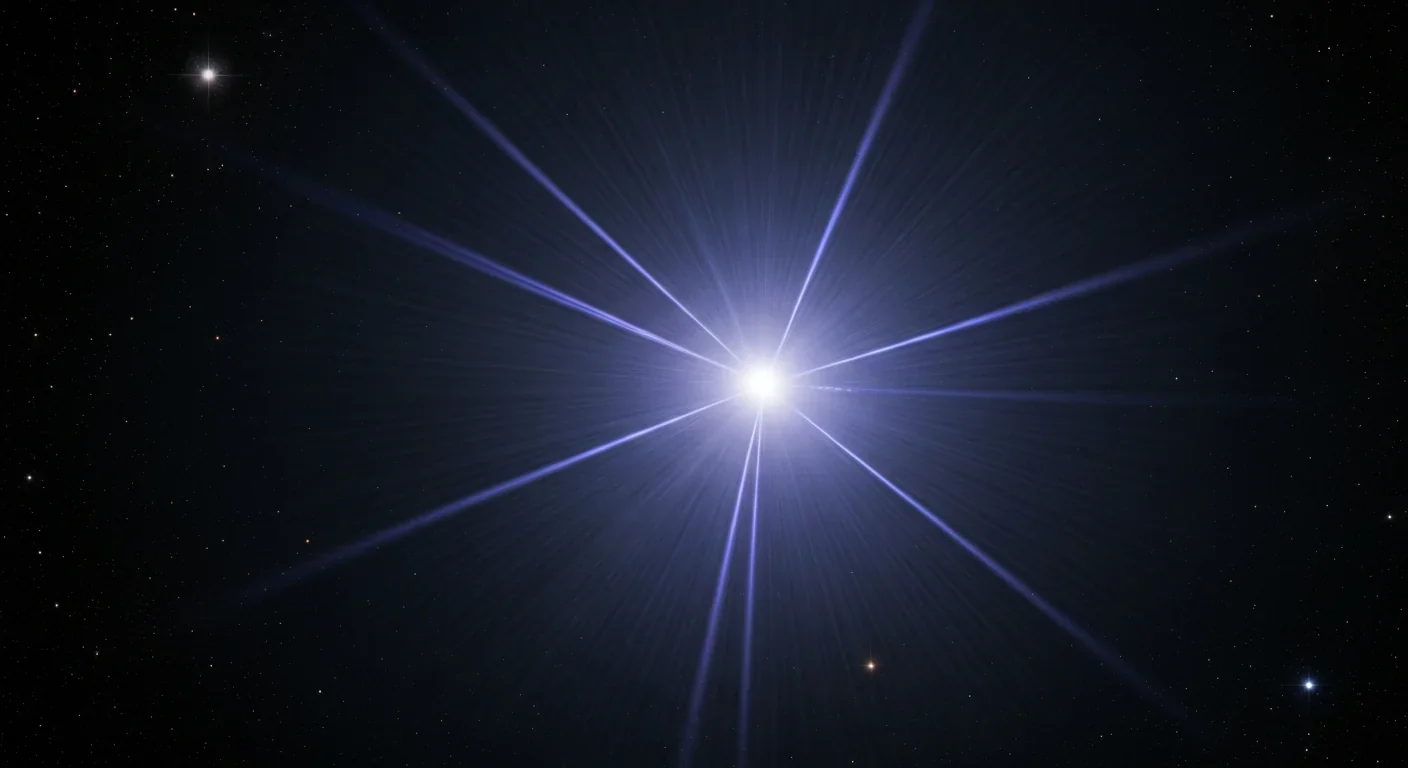
These oscillations aren't random. They're seismic vibrations of the entire neutron star, ringing like a bell struck by a cosmic hammer. By analyzing these frequencies, astrophysicists can probe the interior structure of the magnetar: the thickness of its crust, the density of its core, the strength of its magnetic field at different depths. It's like doing seismology on an object the mass of the Sun compressed to the size of a city.
More common are the smaller bursts: brief flashes of X-rays and gamma rays that magnetars emit sporadically. These shorter bursts, lasting milliseconds to seconds, happen when smaller-scale magnetic reconnection events or crustal adjustments release energy. Even these "small" events can outshine the Sun's entire X-ray output.
For years, fast radio bursts (FRBs) were one of astronomy's deepest mysteries. These millisecond-duration pulses of radio waves, some bright enough to be detected from billions of light-years away, appeared randomly across the sky. Theories ranged from colliding neutron stars to, inevitably, aliens.
Then came April 28, 2020.
That day, the magnetar SGR 1935+2154, located about 30,000 light-years away in the constellation Vulpecula, emitted a bright radio burst simultaneously with an X-ray flare. Multiple radio telescopes, including CHIME and STARE2, caught the event. It was the first FRB detected within our own galaxy and the first definitively linked to a magnetar.
The April 2020 detection of FRB 200428 from magnetar SGR 1935+2154 provided the first direct evidence linking magnetars to the mysterious fast radio burst phenomenon, solving one of astronomy's biggest puzzles.
The connection between magnetars and FRBs now seems solid, though the exact mechanism remains debated. One leading model suggests that when a magnetar flare ejects a shell of magnetized plasma, the interaction between the outflowing material and the surrounding environment can generate coherent radio emission. The details involve complex plasma physics and require just the right conditions, which explains why only some magnetar bursts produce detectable radio signals.
Some FRBs repeat, flashing multiple times over days or months. Others appear once and vanish. The repeating FRBs might come from young, active magnetars still undergoing frequent crustal adjustments. The one-off events could be from older, more quiescent magnetars experiencing rare giant flares.
Not all astrophysicists agree magnetars explain all FRBs. Some extremely bright, distant FRBs might require different engines. But for the local, repeating FRBs? Magnetars fit the bill remarkably well.
Most magnetars sit relatively quietly in their birth nebulae, the expanding debris of their progenitor supernovae. But not all.
In 2025, NASA's Hubble Space Telescope tracked a magnetar racing through the Milky Way at approximately 250 kilometers per second. This magnetar, cataloged as Swift J1818.0-1607, appears to have been ejected from its birthplace, possibly kicked by an asymmetric supernova explosion.
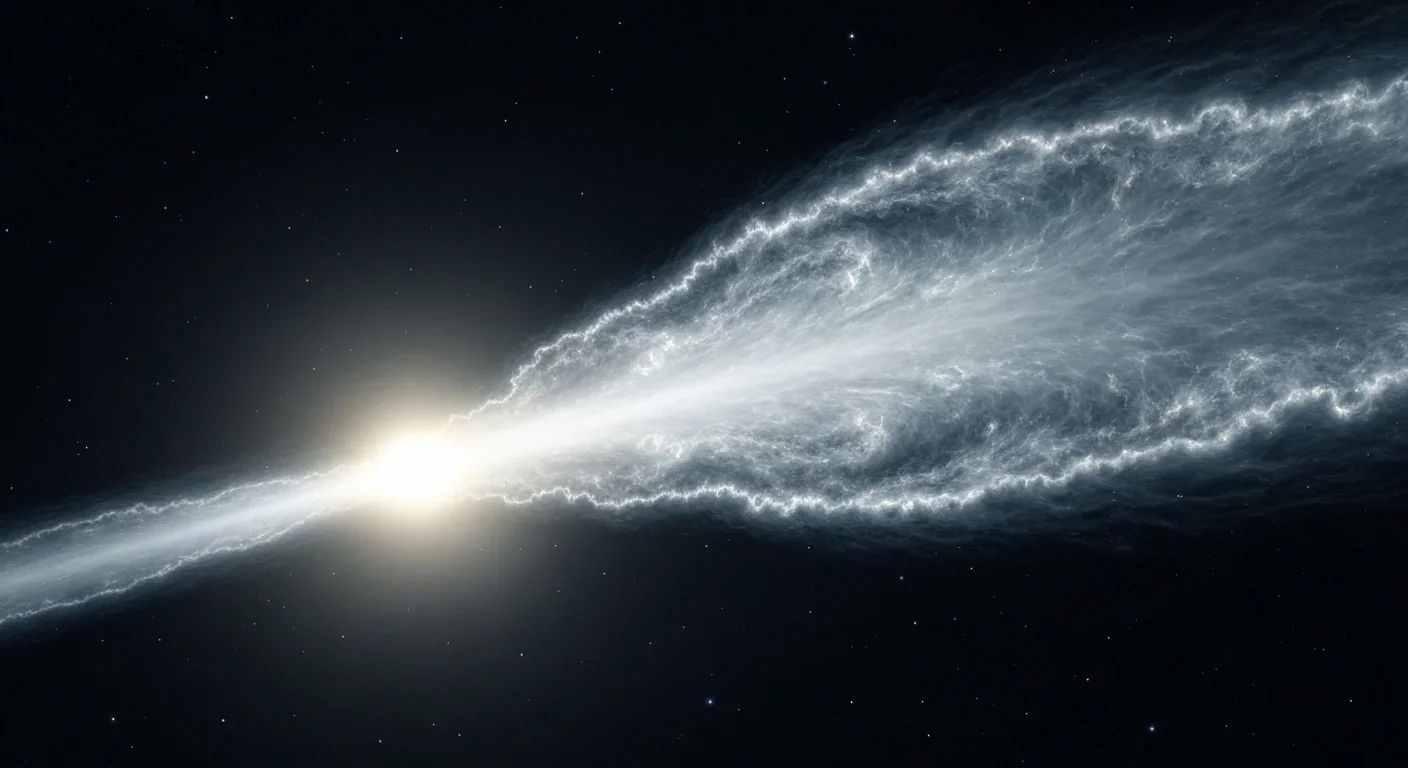
These runaway magnetars pose intriguing questions. As they plow through interstellar gas at high speed, they create bow shocks, compressed regions where their magnetic fields interact with the surrounding medium. Some of the radio emission we detect from magnetars might actually come from these bow shock interactions rather than the magnetar itself.
The presence of high-velocity magnetars also suggests that supernova kicks, well-documented for ordinary pulsars, can occur for magnetar-forming supernovae too. This complicates formation models but provides valuable data about the explosion dynamics.
Not all magnetars announce themselves immediately. In recent years, astronomers have identified what they call ultra-long period magnetars: neutron stars with rotation periods exceeding 100 seconds that suddenly "turn on" after remaining dormant for possibly thousands of years.
The standard pulsar mechanism shouldn't work for such slow rotators. Pulsars generate their characteristic beams through rotation-powered processes that become inefficient below certain spin rates. Yet these ultra-long period objects pulse, flare, and behave like magnetars.
The leading explanation? These are old magnetars whose magnetic fields have decayed to the point where they stopped emitting detectable radiation. They cooled, darkened, and entered a quiescent phase. But internally, their still-substantial magnetic fields continued to evolve. Eventually, a crustal adjustment or field reconfiguration reactivated emission mechanisms, and the magnetar "woke up."
"For every active magnetar we detect, there could be dozens or hundreds of dormant ones, invisible until they decide to flare back to life. The total magnetar population in our galaxy might number in the thousands."
- Ultra-long period magnetar research, arXiv 2025
This has profound implications. It means the census of magnetars might be vastly incomplete. For every active magnetar we detect, there could be dozens or hundreds of dormant ones, invisible until they decide to flare back to life. The total magnetar population in our galaxy might number in the thousands rather than the few dozen we currently know.
Beyond their role as cosmic lighthouses and FRB engines, magnetars might also be cosmic forges for heavy elements. When two neutron stars collide, the resulting kilonova produces a significant fraction of the universe's gold, platinum, and other heavy elements through rapid neutron capture (r-process nucleosynthesis).
But recent models suggest magnetar flares, particularly giant flares, can also drive r-process nucleosynthesis. When a giant flare ejects material at relativistic speeds, neutron-rich matter from the neutron star's outer layers gets caught up in the outflow. The extreme neutron density and rapid cooling create conditions ideal for building heavy atomic nuclei.

The contribution from magnetar flares might not match the total output from neutron star mergers, but given that flares happen more frequently than mergers, magnetars could account for a non-trivial fraction of heavy elements. Every gold ring might contain atoms forged not just in colliding neutron stars, but in the magnetic tantrums of solitary magnetars.
For physicists, magnetars are invaluable natural laboratories. We cannot create quadrillion-gauss magnetic fields on Earth. We can barely approach a millionth of that strength in the most advanced laboratory facilities. Magnetars give us access to regimes where quantum electrodynamics, general relativity, and nuclear physics intersect in ways we can observe but not yet fully replicate.
Consider the Landau levels: in a strong magnetic field, electrons can only occupy discrete energy states perpendicular to the field. In magnetar fields, only the lowest Landau level is accessible, fundamentally changing how matter absorbs and emits radiation. This affects the opacity of the neutron star atmosphere, the polarization of emitted X-rays, and the cooling rate of the star.
Or consider magnetic field decay itself. Magnetars lose energy primarily through magnetic dissipation and radiation rather than rotational spindown like ordinary pulsars. Tracking this decay over decades provides empirical constraints on poorly understood processes like ambipolar diffusion and Hall drift in superconducting neutron matter.
Magnetars serve as natural physics laboratories where quantum electrodynamics, general relativity, and nuclear physics collide at extremes impossible to recreate on Earth, offering glimpses into regimes where our most fundamental theories face their ultimate test.
Some of the most exotic predictions involve vacuum birefringence: the splitting of light into different polarization modes as it passes through the magnetar's magnetosphere. This effect, predicted by QED but never directly observed in a laboratory, has been tentatively detected in data from magnetars. Confirming it would represent a triumph for fundamental physics.
Despite decades of observations, magnetars guard many secrets. We still don't know exactly which stellar progenitors produce magnetars. The binary evolution pathways, spin rates at birth, and magnetic field generation mechanisms remain areas of active research and debate.
The connection between magnetar bursts and crustal mechanics is understood in broad strokes but lacks detailed predictive power. We can't forecast when a magnetar will flare any more than we can predict earthquakes on Earth.
The relationship between magnetars and high-magnetic-field pulsars is murky. Are they distinct populations or part of a continuum? Some neutron stars classified as pulsars exhibit magnetar-like bursts. Some objects initially classified as magnetars turn out to have magnetic fields in the "normal" high-10^13-gauss range. The boundaries are blurrier than we'd like.
And then there's the tantalizing possibility that not all magnetar bursts are caused by internal processes. Recent studies have proposed that planets or debris orbiting magnetars could trigger some X-ray bursts through tidal interactions or accretion events. If confirmed, this would add another layer of complexity to magnetar phenomenology and raise questions about how planetary systems survive supernova explosions.
Magnetars represent the universe showing off. They're what happens when you take matter, energy, and magnetic fields and push them to the absolute limit of what the laws of physics allow. Stronger magnetic fields might not be physically possible; beyond a certain point, the magnetic energy density would exceed the binding energy of the neutron star itself, and the star would tear apart.
In 0.1 seconds of a giant flare, a magnetar releases more energy than our Sun will produce over the next 150,000 years. In that brief flash, we get a glimpse of physics operating at extremes we can barely comprehend, let alone reproduce. When that radiation sweeps across our detectors, carried by photons that left a magnetar decades or millennia ago, we're not just observing distant cosmic events. We're conducting experiments in fundamental physics that no laboratory on Earth could ever perform.
Every magnetar burst is a gift: a data point from the edge of possibility. Every seismic oscillation encodes information about matter compressed beyond imagination. Every radio burst linked to a magnetar helps solve the FRB mystery and connects phenomena across the electromagnetic spectrum.
These magnetic monsters, forged in the collapse of massive stars and powered by fields that warp spacetime itself, continue to surprise us. As our instruments improve and our theoretical models mature, magnetars will keep teaching us about the universe's capacity for extremity and beauty in equal measure. Because when you're the strongest magnet in the cosmos, subtle just isn't your style.
Project Orion was a real 1960s program to reach other stars by detonating 800 nuclear bombs behind a spacecraft. The physics worked and the engineering was feasible, but the 1963 nuclear test ban treaty killed it. It remains the most credible interstellar spacecraft ever designed.

The locus coeruleus, a tiny brainstem structure, degenerates decades before Alzheimer's symptoms appear. Its loss cripples the brain's inflammation control, waste clearance, and sleep regulation. New imaging tools and noradrenergic therapies offer hope for early detection and prevention.

Research shows the sharing economy often increases total resource consumption through the Jevons paradox and rebound effects. Ride-sharing adds billions of vehicle miles, co-working spaces use more energy per worker, and diffused responsibility erodes conservation behavior. Breaking the paradox requires congestion pricing, accountability design, and matching sharing models to appropriate resource types.

Psychological reactance theory explains why banning or restricting things makes people want them more. From Prohibition to the Streisand effect to scarcity marketing, research shows that threatening people's freedom reliably backfires, and autonomy-supportive communication is far more effective.

A carnivorous pitcher plant in Borneo evolved to house bats instead of trapping insects, gaining up to 95% of its nitrogen from bat guano. The plant even built an ultrasonic reflector to help bats find it, revealing that carnivory in plants is a flexible spectrum.

The quantified self movement began as a hacker-ethos pursuit of personal insight, but corporate wearables now funnel biometric data to employers, insurers, and data brokers. With 81% of Americans wrongly believing health apps are HIPAA-protected, a regulatory void enables health data to be sold for pennies while generating anxiety instead of empowerment.

CXL memory pooling lets servers dynamically share DRAM over a cache-coherent interconnect, eliminating the 40% stranded memory waste in data centers. With commercial hardware now shipping and Azure deploying CXL cloud instances, this technology promises to cut memory costs by 50% while enabling composable infrastructure.

Loading featured articles...