Project Orion: Nuclear Bomb Starship That Almost Was
Project Orion: Nuclear Bomb Starship That Almost Was
Europa Clipper Radiation Vault: Surviving Jupiter
VASIMR Plasma Engine: Could It Transform Mars Travel?
Iapetus Equatorial Ridge: The Solar System's Strangest Mountain

Titan's Hidden Ocean: Ammonia Keeps Water Liquid
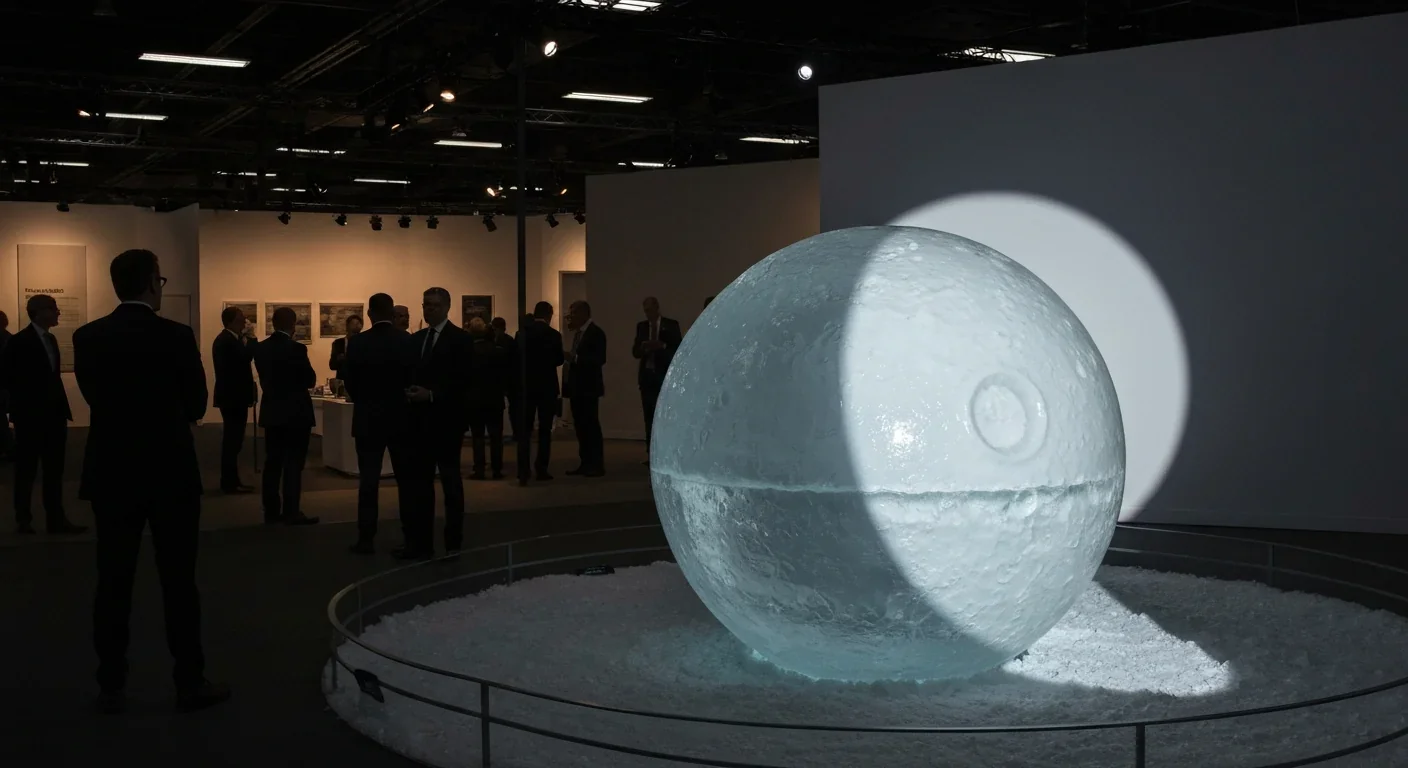
Mimas: How Saturn's Death Star Moon Hides an Ocean
TL;DR: The Mira AB binary system demonstrates how a dying red giant can feed its white dwarf companion across 70 AU through wind Roche lobe overflow, challenging traditional mass transfer models. Multi-wavelength observations reveal an X-ray bridge, accretion disk, and a spectacular 13-light-year UV tail.
Imagine a star so bloated it could engulf the orbit of Mars, hemorrhaging the mass of an entire Earth every decade, while a tiny white dwarf companion gorges on the leftovers from 70 astronomical units away. That's wider than the distance from the Sun to Pluto. The Mira AB system, parked just 300 light-years from Earth in the constellation Cetus, is one of the most dramatic examples of stellar symbiosis ever documented.
It's also leaving astronomers scrambling to update their models, because according to the old textbooks, this kind of mass transfer shouldn't work at such extreme distances. The evidence across every wavelength of light says otherwise, and the implications stretch from stellar physics to the origins of cosmic explosions.
Mira A is the original "wonderful star," literally. Dutch astronomer David Fabricius spotted it flickering in and out of visibility back in 1596, making it one of the first variable stars ever recorded. We now know it's a pulsating asymptotic giant branch red giant with a diameter roughly 470 times that of the Sun and a mass of about 1.2 solar masses. It expands and contracts over a 332-day cycle that causes its brightness to swing by a factor of 1,500, sometimes visible to the naked eye, sometimes vanishing entirely from view.
That pulsation isn't just a light show. Each expansion drives powerful stellar winds outward at speeds of 5 to 20 kilometers per second, carrying away roughly one ten-millionth of the Sun's mass every year. That translates to about one Earth mass every decade, a staggering rate of cosmic shedding. AGB stars like Mira are actually the primary factories of cosmic dust in the universe, and their winds enrich the interstellar medium with heavy elements. Over thousands of years, these winds have sculpted a circumstellar environment around Mira that stretches for light-years in every direction.
Orbiting this dying giant at about 70 AU, with some estimates placing the average separation closer to 100 AU, Mira B is a white dwarf with an orbital period of roughly 500 years. Recent flickering analysis by Zamanov and colleagues found it to be surprisingly lightweight, just 0.24 plus or minus 0.04 solar masses, making it an extremely low-mass white dwarf that contradicts earlier estimates around 0.6 solar masses. Despite the vast gap between the two stars, Mira B has managed to build an accretion disk roughly 10 AU in radius, fed entirely by its companion's wind. The disk glows in ultraviolet light with a luminosity of about 0.91 times that of our Sun.
The story of Mira begins, appropriately enough, with wonder. When Fabricius first recorded its disappearance from the night sky in August 1596, he couldn't have known he was looking at a star in the throes of death. The name "Mira," meaning "wonderful" in Latin, was given later by Johannes Hevelius, who carefully tracked its 11-month brightness cycle through decades of patient observation.
For centuries, Mira was studied as a solitary curiosity, a pulsating red giant and nothing more. It wasn't until the early 20th century that astronomers realized it had a companion. Robert Grant Aitken visually confirmed the binary nature in 1923, but the real breakthroughs came much later. In 1995, the Hubble Space Telescope resolved Mira B in ultraviolet light, revealing not just a faint companion but an accretion disk glowing with captured material. Then in January 2007, astronomers at the Keck Observatory announced the discovery of what appeared to be a protoplanetary disk around Mira B, further evidence of substantial material capture.
This was deeply puzzling. Traditional models of binary mass transfer rely on Roche lobe overflow, where a bloated star expands until material spills directly onto its partner through a gravitational saddle point. But that requires the stars to be close, often just a few stellar radii apart. Mira's two components are separated by roughly 10 billion kilometers. By the old rules, no significant mass should be making the journey.
Despite being separated by a distance wider than our entire solar system, Mira A's stellar wind still manages to feed its companion, a process that challenges decades of binary star models.
The resolution came through a mechanism called wind Roche lobe overflow (WRLOF). In this scenario, Mira A's wind is slow enough that it reaches the gravitational sphere of influence, the Roche lobe, before achieving escape velocity. The wind gets trapped, funneled through the inner Lagrangian point, and gravitationally focused onto the white dwarf. A comprehensive study modeling 375 parameter combinations across white dwarf mass, donor mass, donor radius, and separation demonstrated that WRLOF can dominate in binaries far wider than classical Roche lobe overflow would allow, provided the wind stays slow enough.
Three-dimensional hydrodynamic simulations using the PHANTOM code confirmed that the standard Bondi-Hoyle-Lyttleton accretion model, the classic framework for wind capture dating back to the 1930s and 1940s, systematically overestimates how much material gets accreted in slow-wind systems like Mira. A geometrically corrected model that accounts for wind aberration from orbital motion matches the simulations much better, reducing predicted accretion efficiency by up to a factor of two. The wind doesn't just fall straight in. Orbital motion tilts the effective accretion cylinder, changing everything.
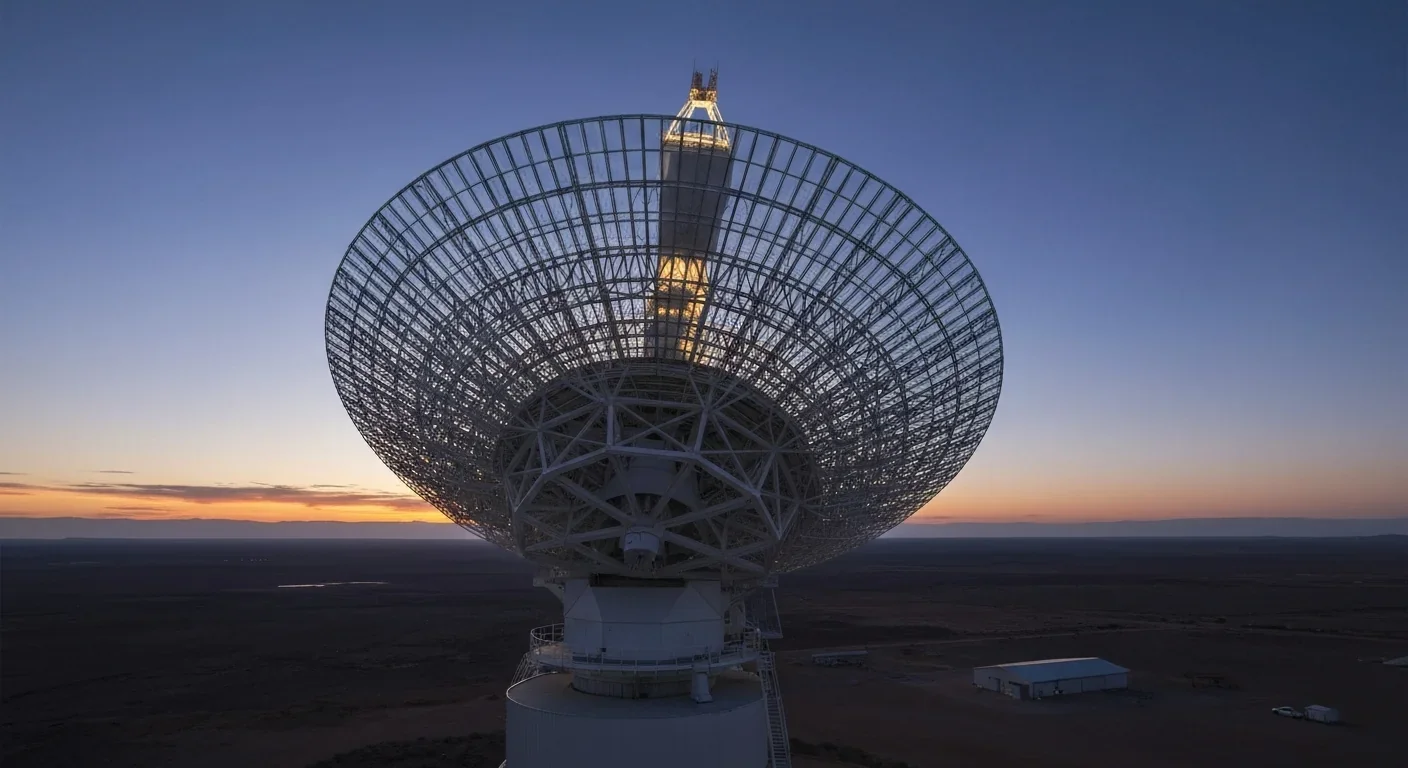
What makes Mira AB such a productive laboratory is its proximity. At just 300 light-years, astronomers can study it across the electromagnetic spectrum with a level of detail impossible for more distant systems. Each wavelength reveals a different piece of the puzzle.
Hubble (Ultraviolet): The Space Telescope first resolved Mira B in the 1990s, confirming the presence of an accretion disk. The UV emission comes from the hot inner regions where accreted material spirals inward and heats up to tens of thousands of degrees. Flickering analysis in the Johnson B and V bands revealed peak-to-peak amplitudes of 0.11 to 0.28 magnitudes, allowing researchers to estimate the disk luminosity and pin down the accretion rate at approximately 6.8 times 10 to the negative ninth solar masses per year. That means Mira B captures roughly 7 percent of everything Mira A throws off.
Chandra (X-ray): Observations with NASA's Chandra X-ray Observatory revealed something stunning: a bridge of hot gas connecting Mira A to Mira B. This X-ray bridge is the smoking gun for active mass transfer, showing material streaming across the binary in real time. The emission comes from gas heated to millions of degrees as it crashes onto the white dwarf's surface and accretion disk. The detection proved that wind accretion in this wide binary isn't a theoretical prediction but an observable, ongoing process.
"Observations with the Chandra X-ray Observatory have revealed a bridge of matter flowing from the primary star to the companion."
- Star Facts, on the Chandra detection of active mass transfer in Mira AB
ALMA (Millimeter): Submillimeter and millimeter observations have mapped the molecular gas in Mira's circumstellar environment, revealing the structure of the wind and the distribution of dust and maser-emitting molecules like SiO and water vapor. These observations trace the cooler, denser material farther from the white dwarf, completing the thermal picture.
GALEX (Ultraviolet): The most jaw-dropping discovery came in 2007, when NASA's Galaxy Evolution Explorer satellite revealed that Mira is trailing a comet-like tail of material stretching 13 light-years behind it. Nothing like it had ever been seen around a star before. The tail traces roughly 30,000 years of mass-loss history.
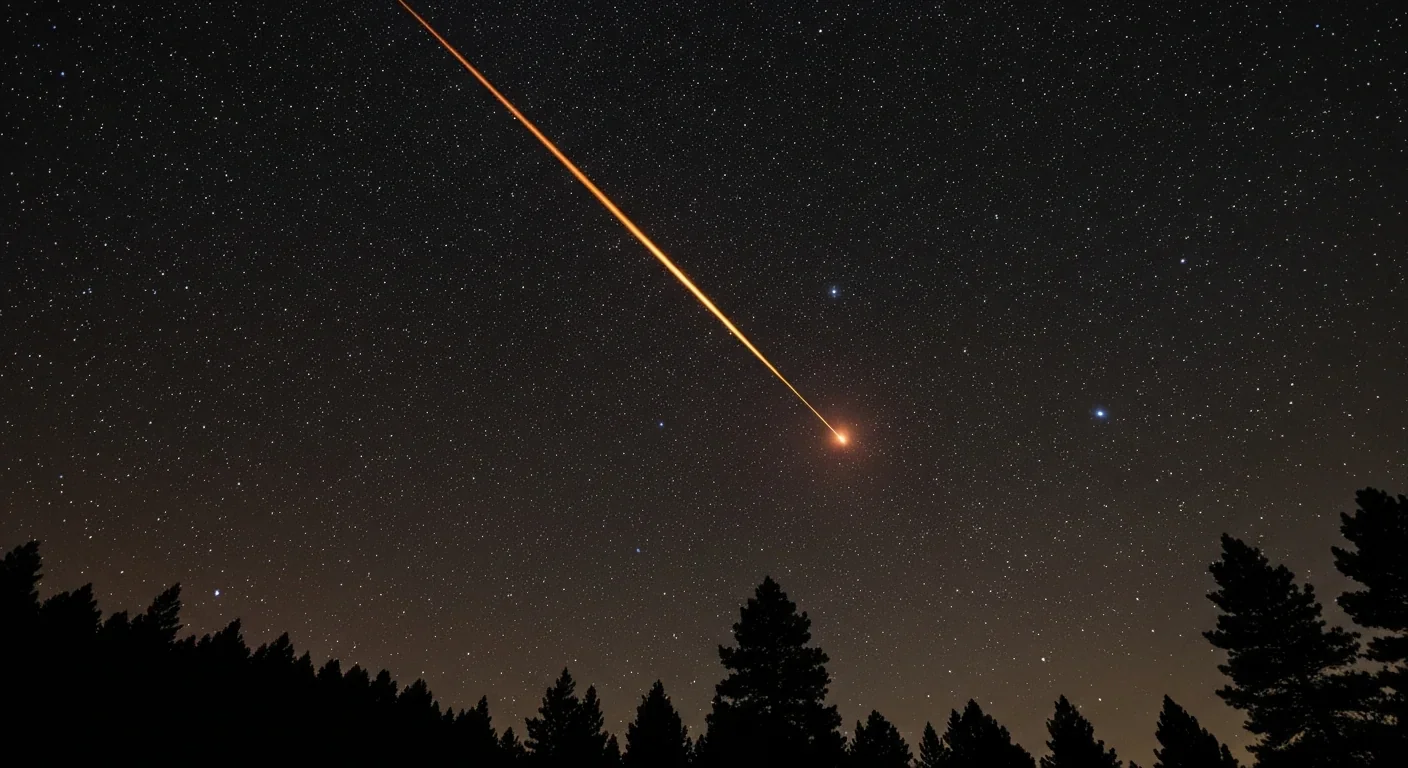
That GALEX tail deserves its own moment. Thirteen light-years. That's more than three times the distance from the Sun to Alpha Centauri. And it's made entirely of material shed by Mira A over tens of thousands of years, visible only in ultraviolet light because the gas is interacting with the surrounding interstellar medium.
The physics are actually elegant. Mira is hurtling through space at about 130 km/s relative to the local interstellar gas. In front of the star, a bow shock forms where the stellar wind meets the interstellar medium head-on, like the bow wave of a speedboat cutting through water. Behind it, ejected material gets left in its wake, creating the long luminous trail that records roughly 30,000 years of mass-loss history.
Because AGB stars can lose 50 to 70 percent of their initial mass during this phase, the tail is essentially a fossil record of stellar death written in ultraviolet light. The material being shed, rich in heavy elements and cosmic dust, will eventually be recycled into new stars, planets, and potentially the building blocks of life. NASA described Mira as literally "shedding material that will be recycled into new stars, planets and possibly life."
Mira's 13-light-year tail is the longest known structure created by a single star's mass loss, a fossil record of 30,000 years of stellar death visible only in ultraviolet light.

Here's where it gets really interesting for the big-picture thinkers. White dwarfs have a maximum mass they can sustain, the Chandrasekhar limit, roughly 1.44 solar masses. Cross that line and the star can no longer support itself through electron degeneracy pressure. Carbon fusion ignites throughout the entire star in a fraction of a second, producing a Type Ia supernova. Because these explosions have consistent peak brightnesses, they serve as "standard candles" for measuring cosmic distances, so understanding what creates them matters enormously for cosmology.
Could Mira B get there? The math looks unpromising. At 0.24 solar masses, Mira B would need to gain roughly 1.2 solar masses to reach the limit. At its current accretion rate, that would take about 175 billion years, far longer than the current age of the universe. And Mira A's AGB phase won't last anywhere near that long.
Multiple studies have now converged on a clear conclusion. A comprehensive analysis of 189 normal Type Ia supernovae found zero evidence of red-giant companions in any of them, using seven independent diagnostic methods including hydrogen and helium emission lines, radio and X-ray limits, and light-curve analysis. Simulations of symbiotic binaries transferring mass via the BHL mechanism show that the white dwarf typically loses more mass through nova eruptions than it gains through accretion. The orbits tend to widen over time as angular momentum is carried away by escaping wind material.
Mira AB almost certainly won't go supernova. But it remains a crucial test case. Understanding precisely why it won't helps astronomers narrow down which binary configurations actually can produce these cosmic explosions. Every system ruled out is one more constraint on the models, pushing the field closer to solving one of astrophysics' most persistent puzzles: where do Type Ia supernovae actually come from?
Mira AB benefits from observations at virtually every major telescope facility on the planet. The ALMA array in Chile's Atacama Desert has mapped molecular gas at millimeter wavelengths to reveal the three-dimensional structure of Mira's wind and how pulsation-driven shocks create the conditions for dust formation close to the stellar surface.
Theoretical work is equally international. Simulations by Toala, Tejeda, and Vasquez-Torres used three-dimensional SPH simulations to show that the geometrical correction to BHL accretion faithfully reproduces simulated efficiencies within 10 to 20 percent. Research from Israeli institutions has mapped the boundary between WRLOF and BHL regimes across hundreds of parameter combinations. Studies on stratified accretion flows have shown that peak accretion rates occur when the wind's scale height equals the gravitational radius, a prediction directly testable with Mira AB.
This collaboration matters because the physics span scales from astronomical units to light-years, and from radio frequencies to X-rays. No single team or telescope can see it all. Mira AB has become something of a benchmark system, the go-to example that theorists use to test their models of wind accretion and binary interaction against real observational data.
Mira AB is more than a curiosity. It's a Rosetta Stone for understanding the final chapters of stellar evolution in binary systems. For single stars, the AGB phase represents the transition from a hydrogen-burning giant to a white dwarf surrounded by a planetary nebula. In a binary, the companion gravitationally sculpts the wind, creating asymmetric outflows, accretion disks, and jet structures that reshape the final stages of mass loss in ways we're only beginning to understand.
Mira A's kappa-mechanism pulsations directly modulate the density and velocity of the wind, meaning the accretion rate onto Mira B fluctuates with the 332-day cycle. Understanding this time-dependent accretion is key to modeling symbiotic stars as a class, not just this one famous system.
"Mira is shedding material that will be recycled into new stars, planets and possibly life as it hurls through our galaxy."
- NASA Science, on the GALEX discovery of Mira's ultraviolet tail
The broader lesson is humbling. More than half of all stars in the Milky Way exist in binary or multiple systems, and many of those partnerships shape how the stars live, age, and ultimately die. What we learn from Mira applies far beyond one system in the constellation Cetus. It applies to the billions of binary stars across our galaxy that are quietly exchanging mass, sculpting nebulae, and seeding the interstellar medium with the elements that planets and life are made from.
Mira teaches us that even across the vast emptiness of space, gravity finds a way to connect things. And in that connection, as material flows from one star to another and trails off into the void, the universe quietly builds the raw materials for everything that comes next.
Project Orion was a real 1960s program to reach other stars by detonating 800 nuclear bombs behind a spacecraft. The physics worked and the engineering was feasible, but the 1963 nuclear test ban treaty killed it. It remains the most credible interstellar spacecraft ever designed.

The locus coeruleus, a tiny brainstem structure, degenerates decades before Alzheimer's symptoms appear. Its loss cripples the brain's inflammation control, waste clearance, and sleep regulation. New imaging tools and noradrenergic therapies offer hope for early detection and prevention.

Research shows the sharing economy often increases total resource consumption through the Jevons paradox and rebound effects. Ride-sharing adds billions of vehicle miles, co-working spaces use more energy per worker, and diffused responsibility erodes conservation behavior. Breaking the paradox requires congestion pricing, accountability design, and matching sharing models to appropriate resource types.

Psychological reactance theory explains why banning or restricting things makes people want them more. From Prohibition to the Streisand effect to scarcity marketing, research shows that threatening people's freedom reliably backfires, and autonomy-supportive communication is far more effective.
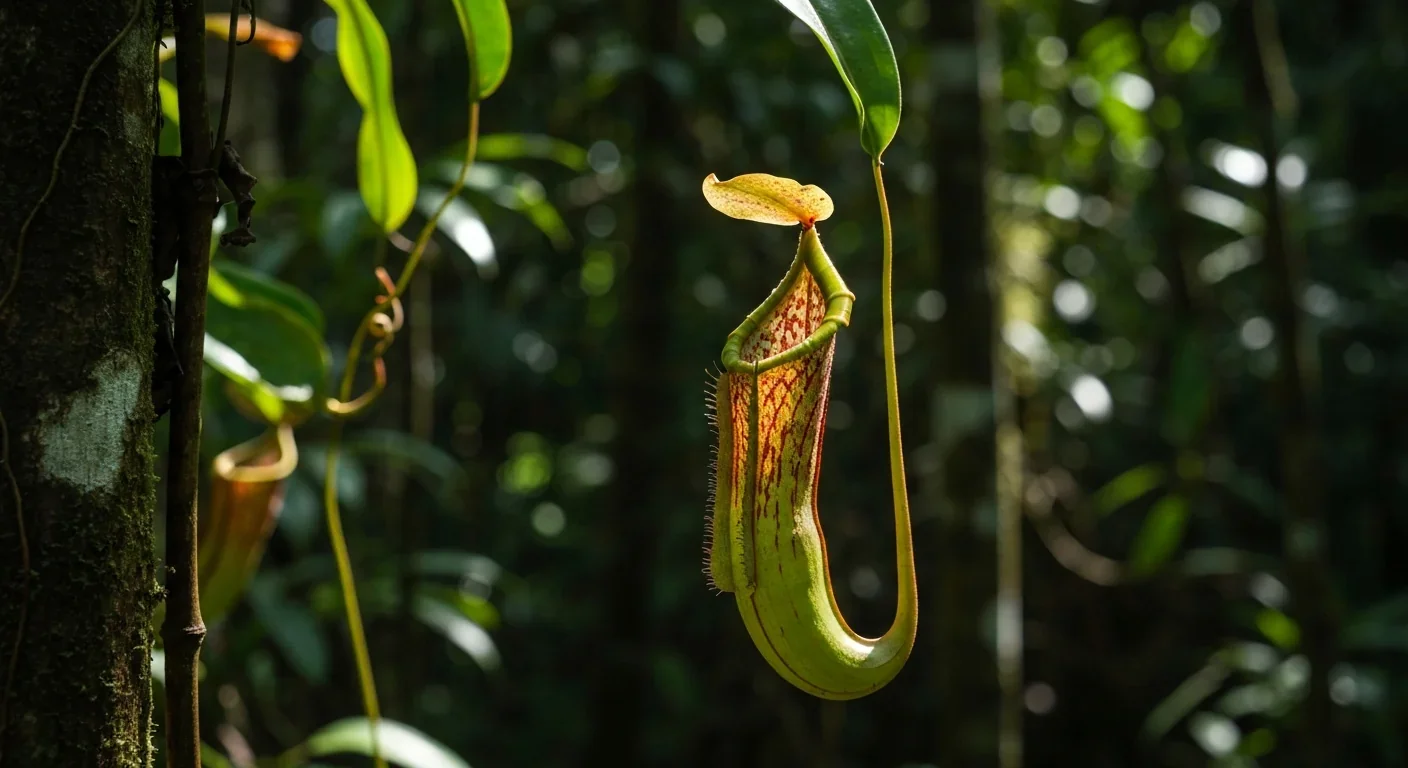
A carnivorous pitcher plant in Borneo evolved to house bats instead of trapping insects, gaining up to 95% of its nitrogen from bat guano. The plant even built an ultrasonic reflector to help bats find it, revealing that carnivory in plants is a flexible spectrum.

The quantified self movement began as a hacker-ethos pursuit of personal insight, but corporate wearables now funnel biometric data to employers, insurers, and data brokers. With 81% of Americans wrongly believing health apps are HIPAA-protected, a regulatory void enables health data to be sold for pennies while generating anxiety instead of empowerment.

CXL memory pooling lets servers dynamically share DRAM over a cache-coherent interconnect, eliminating the 40% stranded memory waste in data centers. With commercial hardware now shipping and Azure deploying CXL cloud instances, this technology promises to cut memory costs by 50% while enabling composable infrastructure.

Loading featured articles...