Project Orion: Nuclear Bomb Starship That Almost Was
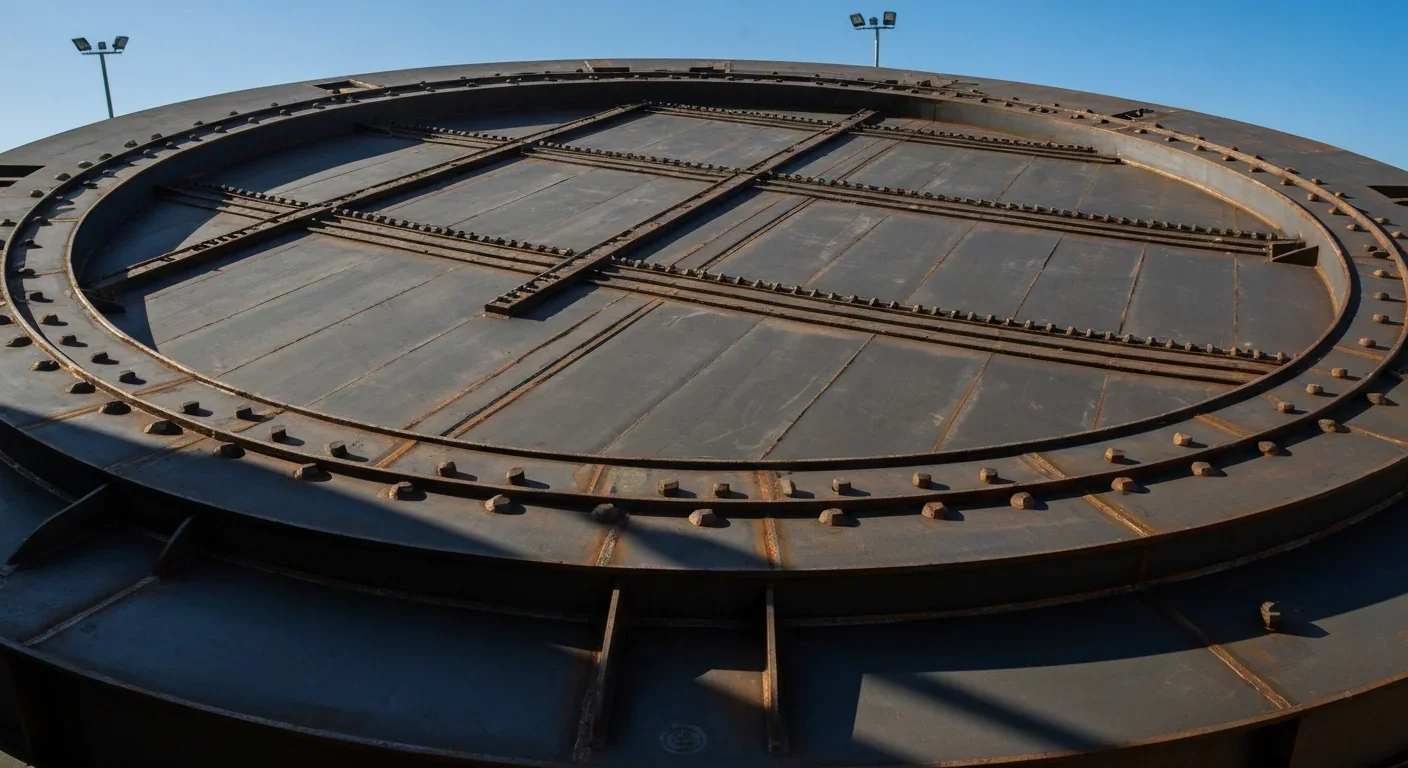
Project Orion: Nuclear Bomb Starship That Almost Was
Europa Clipper Radiation Vault: Surviving Jupiter
VASIMR Plasma Engine: Could It Transform Mars Travel?
Iapetus Equatorial Ridge: The Solar System's Strangest Mountain

Titan's Hidden Ocean: Ammonia Keeps Water Liquid
Mimas: How Saturn's Death Star Moon Hides an Ocean
TL;DR: The Shkadov thruster is a giant mirror positioned near a star that uses radiation pressure to slowly push the entire star system through space. First proposed in 1987, the physics is sound and could relocate our Sun 34,000 light-years over a billion years.
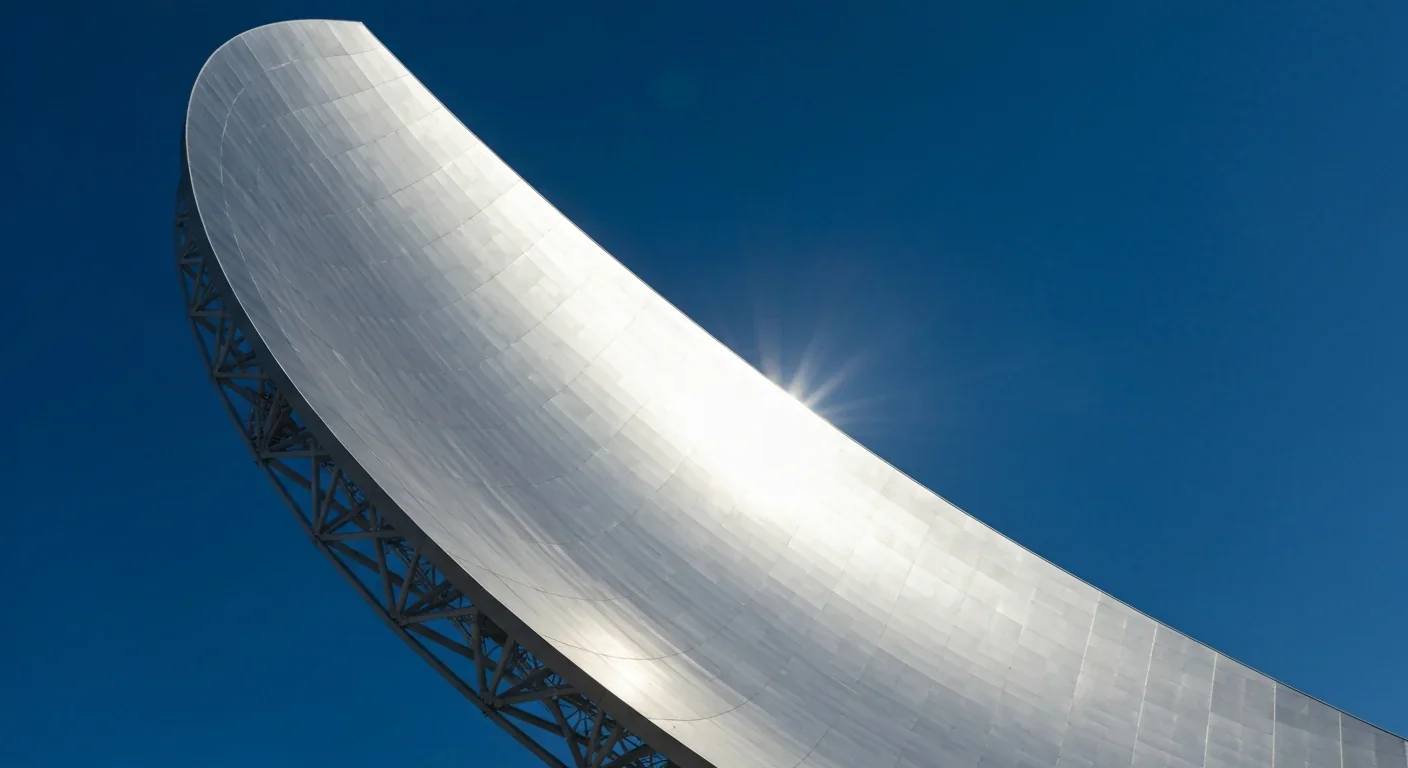
In October 1987, at the International Astronautical Federation's 38th Congress, a Soviet aerospace engineer named Leonid Shkadov presented a paper with an almost comically understated title: "Possibility of controlling solar system motion in the Galaxy." What he proposed inside that paper was anything but understated. Shkadov described a megastructure, a colossal mirror positioned near a star, that could redirect the star's own light to generate thrust. Not thrust for a spacecraft. Thrust for the entire star and everything orbiting it.
Shkadov wasn't some fringe theorist. He served as deputy director of TsAGI, Russia's premier aerospace research institute, from 1986 to 2003. He'd won the USSR State Prize in 1977 for his contributions to engineering. When he proposed what would later bear his name, the Shkadov thruster, he brought the credibility of someone who understood structures, forces, and materials at the highest level.
The idea sat at the intersection of two well-established physics concepts: radiation pressure and gravitational equilibrium. Neither was new. What was new was applying them at a stellar scale.
Here's the thing about light that most people don't think about: it pushes. Every photon that hits a surface transfers a tiny bit of momentum. For a perfect reflector, that pressure doubles, because the photon bounces back and delivers momentum in both directions. At Earth's distance from the Sun, this solar radiation pressure works out to about 9 micronewtons per square meter. That's roughly the weight of a mosquito spread across a dinner table. Completely negligible for everyday purposes.
But scale it up. The Sun pumps out 3.85 x 1026 watts of energy in all directions, continuously, and it's been doing this for 4.6 billion years. If you placed an enormous mirror on one side of the Sun, you'd reflect a portion of that output back in a single direction. The unreflected light on the opposite side keeps streaming away normally. The result is an imbalance, a net force pushing the Sun away from the mirror.
The math works out to a thrust of about 1.28 x 10¹⁸ newtons if you could reflect half the Sun's output. That's a staggering number in absolute terms, roughly equivalent to a billion space shuttle launches happening simultaneously. But the Sun weighs 1.99 x 1030 kilograms. So the acceleration is painfully, almost comically small: about 1.3 x 10⁻¹² meters per second squared. You'd barely notice it if you were standing on Earth. And that's exactly the point.
The thrust from a Shkadov thruster equals roughly a billion space shuttle launches happening simultaneously, yet the Sun is so massive that the resulting acceleration is smaller than the drift of continental plates.
The engineering concept behind the Shkadov thruster is elegant precisely because it's passive. The mirror doesn't orbit the star in the traditional sense. Instead, it sits at a point where the outward push of radiation pressure exactly balances the inward pull of gravity. This makes it what physicists call a statite, a structure that levitates in place without needing engines or fuel. It just hangs there, reflecting light, year after year, for millions of years.
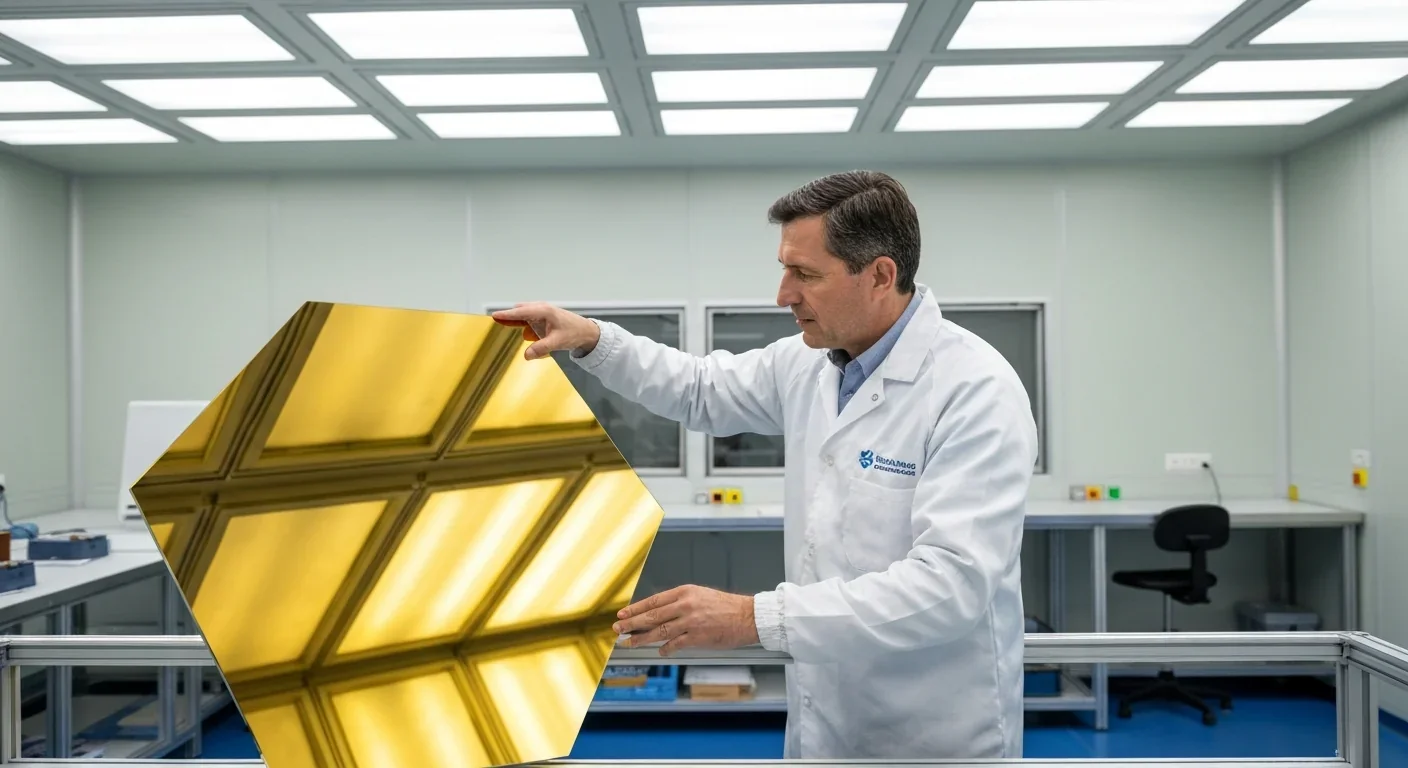
The mirror itself would need to be enormous. We're talking about a spherical cap with a radius on the order of 1 astronomical unit, roughly 150 million kilometers. Its mass would range from 1019 to 1020 kilograms, which is roughly the mass of a small asteroid or, more practically, what you'd get if you dismantled Mercury and hammered it into an impossibly thin reflective sheet. The surface density would need to be incredibly low, on the order of a few grams per square meter, to ensure radiation pressure can hold it aloft.
A 2026 study by Colin McInnes, published in the Monthly Notices of the Royal Astronomical Society, tackled one of the biggest engineering questions: could such a mirror actually be stable? His models showed that a uniform disc-shaped mirror would always be unstable, like trying to balance a plate on a pin. But a ring-shaped design, where most of the mass sits at the outer edge (think tambourine rather than dinner plate), could achieve passive stability. No active control systems needed.
So how fast does this thing actually move a star? The answer depends entirely on how patient you are. And we're talking about patience on a geological, even cosmological, scale.
After one million years of continuous operation, a Shkadov thruster on our Sun would have nudged it to a velocity of about 20 meters per second. That's a brisk jog. The total displacement would be roughly 0.03 light-years, barely a stone's throw in cosmic terms.
But keep it running for a billion years, and the numbers become genuinely impressive. The velocity climbs to 20 kilometers per second, and the total displacement reaches 34,000 light-years, more than a third of the Milky Way's diameter. You could relocate the solar system from one spiral arm to another. You could steer clear of an approaching danger zone. You could, in theory, reposition your star for better access to resources or more favorable cosmic real estate.
"After one billion years, the speed would be 20 km/s and the displacement 34,000 light-years, a little over a third of the estimated width of the Milky Way galaxy."
- Stellar Engine, Wikipedia
The key insight is that none of this requires violating any known laws of physics. The acceleration is absurdly small, but it's continuous and it compounds. Time does the heavy lifting.
The Shkadov thruster's simplicity is both its greatest strength and its most obvious limitation. If you need to move a star quickly, say to dodge an approaching supernova in the next few million years, a passive mirror won't cut it.
That's where the Caplan thruster comes in. Proposed by physicist Matthew Caplan in 2019, this design is essentially a giant fusion rocket strapped to a star. It uses a Dyson swarm to concentrate stellar energy, then lifts material directly from the star's surface, heating and ejecting it as a directed plasma jet. The result is an acceleration roughly a thousand times greater than the Shkadov approach, potentially reaching velocities of 200 km/s after just 5 million years.
The trade-off is complexity. The Caplan thruster requires active energy conversion, fuel harvesting, and continuous maintenance. The Shkadov thruster, by contrast, has no moving parts, consumes no fuel, and could theoretically operate indefinitely with minimal upkeep.
There's also a hybrid design called the Star Tug, proposed by Alexander Svoronos, which combines aspects of both approaches. Instead of pushing a star from behind like the Caplan engine, it pulls from the front via a gravitational link, but replaces the passive mirror with an active engine. It needs only a single beam of thrust instead of the Caplan engine's two, simplifying the propulsion architecture. In principle, it could accelerate the Sun to about 27% the speed of light, though that would require burning enough of the Sun's mass to reduce it to a brown dwarf. Not exactly a conservation-friendly approach.
This might be the most interesting question of all. Why would a civilization invest millions of years of effort into nudging its star a few light-years in one direction?
The answers are surprisingly practical. Our galaxy is not a safe neighborhood. Nearby supernovae could sterilize a planet from dozens of light-years away. Cold molecular clouds could disrupt a star's Oort cloud and send a rain of comets toward the inner planets. Rogue stars occasionally wander through populated regions of the galaxy, threatening gravitational chaos.
Then there's the big one. In roughly 4.5 billion years, the Milky Way will collide with the Andromeda Galaxy. Recent simulations using Gaia and Hubble data suggest the probability of a direct hit to our solar system is actually quite low, maybe around 2%. But a civilization thinking on truly long timescales might not be comfortable with those odds. A Shkadov thruster, started early enough, could reposition a star system well away from the merger's most chaotic zones.
A Shkadov thruster started today could, over the next 4.5 billion years, move our solar system 34,000 light-years from its current position, well clear of any predicted danger zones from the Milky Way-Andromeda collision.
Researchers Badescu and Cathcart classified stellar engines in 2000, placing the Shkadov thruster in Class A, the simplest category. Their taxonomy helped formalize what had been a scattered set of ideas into a proper engineering framework.
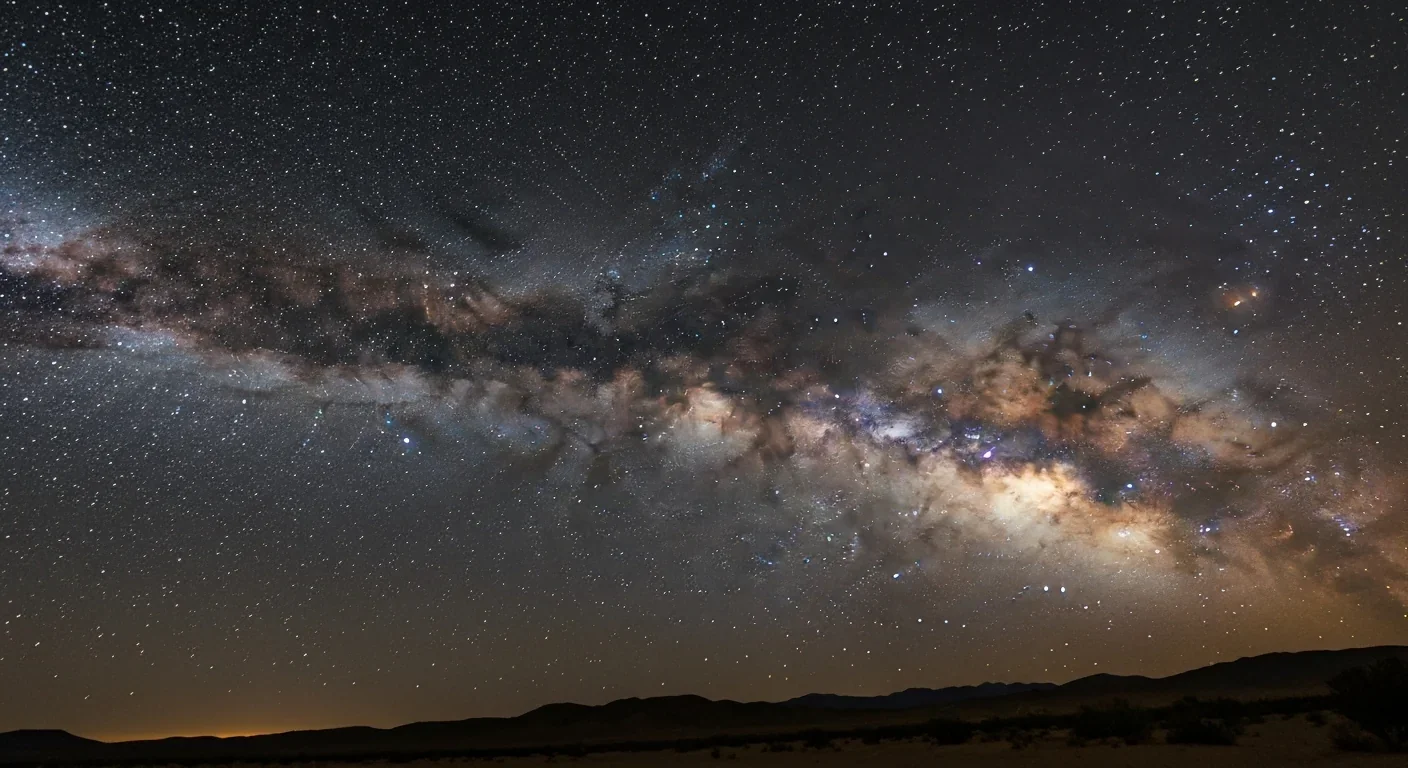
Here's where things get really interesting for the search for extraterrestrial intelligence. If an advanced civilization is already operating a Shkadov thruster, we might be able to detect it. Duncan Forgan has suggested that planet-hunting telescopes like Kepler could spot the distinctive light signatures of a giant mirror hovering near a star.
A Shkadov thruster would produce a unique transit signature quite different from a planet crossing in front of a star. Instead of a smooth dip and recovery in brightness, you'd see an abrupt partial blocking event. The mirror would appear to halt over the star's surface rather than transit fully across it. There might also be an anomalous infrared excess, similar to what astronomers already search for when looking for Dyson spheres.
McInnes' stability models aren't just academic exercises. By refining our understanding of how these structures would behave, his work helps astronomers predict exactly what observable signatures to look for, turning a theoretical concept into a practical SETI search strategy.
"Shkadov thrusters, with the hypothetical ability to change the orbital paths of stars, would be detectable in a similar fashion to the transiting extrasolar planets searched by Kepler."
- Wikipedia, Technosignature
Building a Shkadov thruster requires a Type II civilization on the Kardashev scale, one capable of harnessing the entire energy output of its star. Humanity is currently somewhere around Type 0.7. We're not building any stellar engines soon.
But the concept matters because it forces us to think on timescales we normally ignore. We plan cities for decades, infrastructure for centuries. The Shkadov thruster asks: what if you planned for a billion years? What problems become solvable when you're willing to be that patient? And what does it say about a species that it can conceive of such things long before it can build them?
The Shkadov thruster sits in the same category as Dyson spheres and Alderson disks, structures that are physically possible but engineering impossible for now. The physics is sound. The materials science is theoretically achievable. The only missing ingredient is a civilization advanced enough to attempt it.
That gap between what physics allows and what engineering can deliver is where the most fascinating science lives. The Shkadov thruster isn't a blueprint. It's a thought experiment with math behind it, a way of asking how far the laws of nature would let us go if we had the time and the will. And the answer, it turns out, is across the entire galaxy.
Project Orion was a real 1960s program to reach other stars by detonating 800 nuclear bombs behind a spacecraft. The physics worked and the engineering was feasible, but the 1963 nuclear test ban treaty killed it. It remains the most credible interstellar spacecraft ever designed.

The locus coeruleus, a tiny brainstem structure, degenerates decades before Alzheimer's symptoms appear. Its loss cripples the brain's inflammation control, waste clearance, and sleep regulation. New imaging tools and noradrenergic therapies offer hope for early detection and prevention.

Research shows the sharing economy often increases total resource consumption through the Jevons paradox and rebound effects. Ride-sharing adds billions of vehicle miles, co-working spaces use more energy per worker, and diffused responsibility erodes conservation behavior. Breaking the paradox requires congestion pricing, accountability design, and matching sharing models to appropriate resource types.

Psychological reactance theory explains why banning or restricting things makes people want them more. From Prohibition to the Streisand effect to scarcity marketing, research shows that threatening people's freedom reliably backfires, and autonomy-supportive communication is far more effective.

A carnivorous pitcher plant in Borneo evolved to house bats instead of trapping insects, gaining up to 95% of its nitrogen from bat guano. The plant even built an ultrasonic reflector to help bats find it, revealing that carnivory in plants is a flexible spectrum.

The quantified self movement began as a hacker-ethos pursuit of personal insight, but corporate wearables now funnel biometric data to employers, insurers, and data brokers. With 81% of Americans wrongly believing health apps are HIPAA-protected, a regulatory void enables health data to be sold for pennies while generating anxiety instead of empowerment.

CXL memory pooling lets servers dynamically share DRAM over a cache-coherent interconnect, eliminating the 40% stranded memory waste in data centers. With commercial hardware now shipping and Azure deploying CXL cloud instances, this technology promises to cut memory costs by 50% while enabling composable infrastructure.

Loading featured articles...