Project Orion: Nuclear Bomb Starship That Almost Was
Project Orion: Nuclear Bomb Starship That Almost Was
Europa Clipper Radiation Vault: Surviving Jupiter
VASIMR Plasma Engine: Could It Transform Mars Travel?
Iapetus Equatorial Ridge: The Solar System's Strangest Mountain

Titan's Hidden Ocean: Ammonia Keeps Water Liquid
Mimas: How Saturn's Death Star Moon Hides an Ocean
TL;DR: Solar sail spacecraft navigate the solar system by tacking on sunlight, angling reflective sheets to redirect photon pressure just as sailboats tack against the wind. Missions like IKAROS and LightSail 2 have proven the physics works, and next-generation designs could enable interstellar travel.
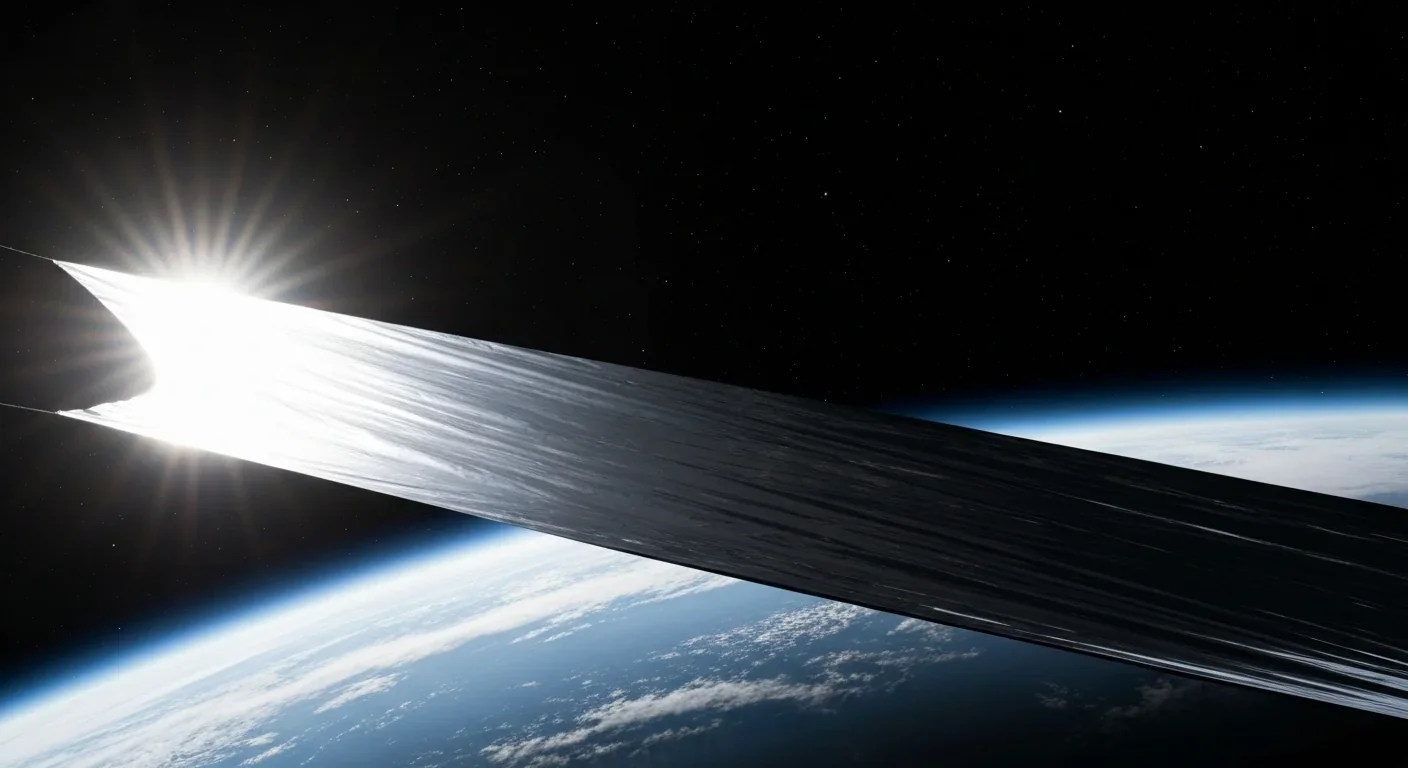
The next revolution in space travel won't come from bigger rockets or exotic fuels. It will ride on something far more elegant: sunlight itself. Right now, spacecraft are navigating the solar system using nothing but photons bouncing off gossamer-thin reflective sheets, and just like a clipper ship can't sail directly into the wind, these solar sailors must tack at precise angles to the Sun. They trade between thrust direction and thrust magnitude to spiral inward, outward, or completely out of the plane of the solar system. The physics is real. The missions are flying. And the implications could reshape how we explore deep space forever.
Photons have no mass, but they carry momentum. When sunlight strikes a reflective surface, each photon bounces off and transfers a tiny kick in the direction perpendicular to that surface. At Earth's distance from the Sun, that kick amounts to about 9.08 micronewtons per square meter of perfectly reflective sail. A real sail operating at roughly 90% reflectivity gets about 8.17 micronewtons per square meter. That's approximately the weight of a mosquito on a dinner table.
Sounds useless? Consider this. A Falcon 9 rocket produces 7.6 million newtons of thrust, but it burns out in under three minutes. A solar sail produces a fraction of a newton, but it never stops pushing. Over six months, a 900-square-meter sail pushing a 40-kilogram spacecraft accumulates roughly 10,600 km/h of velocity change. No fuel consumed. No exhaust. Just light doing work, continuously, for as long as the Sun shines. Solar sails aren't inferior rockets. They're a fundamentally different kind of propulsion, one where patience beats raw power.
The force always pushes perpendicular to the sail's surface, not simply away from the Sun. This is the critical detail that makes steering possible. By tilting the sail relative to incoming sunlight, the spacecraft redirects that perpendicular push into whatever direction it needs. Maximum force hits when the sail faces the Sun head-on. Tilt it to 45 degrees and you trade some magnitude for a sideways component that changes your orbit. Turn it edge-on and thrust drops to zero, an instant pause button. Research shows that 35.26 degrees is the optimal angle when you need maximum tangential push along the orbit, the angle that most efficiently changes where you're going. Engineers call it the sun angle, and it plays a role analogous to the angle of attack for aircraft wings.
The idea is older than you'd think. In 1610, Johannes Kepler wrote to Galileo: "Provide ships or sails adapted to the heavenly breezes, and there will be some who will brave even that void." He'd noticed that comet tails always point away from the Sun and reasoned, correctly, that something was pushing them. Nearly three centuries later, in 1899, Russian physicist Pyotr Lebedev became the first person to actually measure radiation pressure in a laboratory, confirming what Maxwell's electromagnetic theory had predicted. The American physicists Nichols and Hull independently verified the result in 1903. Light pushes on things. It's established, experimental physics, not speculation.
"Provide ships or sails adapted to the heavenly breezes, and there will be some who will brave even that void."
- Johannes Kepler, in a letter to Galileo, 1610
The concept took root in early Soviet space thinking. Yakov Perelman proposed using solar radiation pressure for spacecraft propulsion in his 1915 book Interplanetary Journeys, though he dismissed it as impractical given the minuscule forces involved. Tsiolkovsky, the father of astronautics, wrote the preface to Perelman's 1923 edition. By the 1970s, engineers at NASA's Jet Propulsion Laboratory were studying an audacious concept: an 800-by-800-meter solar sail that could rendezvous with Halley's Comet on its 1986 approach. The mission never flew, but it established the mathematical framework still used today. By 1929, physicist J.D. Bernal was already imagining a spaceship "spreading its large, metallic wings, acres in extent, to the full, might be blown to the limit of Neptune's orbit."
The first actual launch attempt, the Planetary Society's Cosmos 1 in 2005, ended when its Russian rocket booster malfunctioned before the sail could deploy. Then, in 2010, everything changed. JAXA's IKAROS unfurled a 196-square-meter polyimide sail in deep space and proved the physics worked. By 2013, photon pressure alone had changed the spacecraft's velocity by 400 meters per second. The measured thrust was 1.12 millinewtons across the full sail. Tiny but real and relentless. Solar sailing had gone from a centuries-old dream to demonstrated technology in the vacuum of space.
Here's where the nautical analogy becomes more than a metaphor. A sailboat can't sail directly into the wind. Instead, it tacks at angles, zigzagging toward its destination by catching the wind on alternating sides. Solar sail spacecraft face the same fundamental constraint: radiation pressure can never push you toward the Sun. The thrust always has an outward component. You can angle it, redirect it, but you can never flip it sunward. This asymmetry shapes every trajectory a solar sail flies.
So how do you sail inward? The same way a satellite falls from orbit: you slow down. Orient the sail so that thrust opposes your orbital velocity and you bleed off the kinetic energy keeping you at your current distance. As your orbital energy drops, gravity pulls you into a tighter, closer orbit. You spiral inward not by flying toward the Sun, but by losing the speed that was holding you away from it.
To sail toward the Sun, a solar sail doesn't thrust sunward. Instead, it angles to slow itself down, shedding orbital energy so gravity pulls it inward. Same hardware, opposite sail angle, opposite trajectory.
The numbers are striking. A spacecraft with a large sail angled at 45 degrees can spiral from Earth's orbit down to 0.56 AU, between Venus and Mercury, in about 12 months. Flip the sail orientation to add energy instead, and the same spacecraft spirals outward to 1.6 AU in 18 months, roughly Mars distance. Same hardware, opposite trajectory, different sail angle. NASA itself describes the concept directly: "Like a sailboat turning to capture the wind, the solar sail can adjust its orbit by angling its sail."
One elegant property keeps tacking viable everywhere in the solar system. Both solar radiation pressure and gravitational pull decrease with the inverse square of distance from the Sun, so their ratio stays constant regardless of location. A sail that can maneuver at Earth's distance can geometrically tack at Jupiter's distance too, even though both forces are 25 times weaker there. The geometry of tacking doesn't care how far you are from the Sun.
IKAROS remains the gold standard. Launched by Japan's space agency JAXA in 2010, it carried 80 liquid crystal panels embedded in its sail that could switch between reflective and transparent states. By making one side of the spinning sail more reflective than the other, mission controllers changed the solar angle by half a degree over 23 hours without firing a single thruster. The spacecraft operated for over 15 years, proving that photon propulsion works for genuinely long-duration missions.
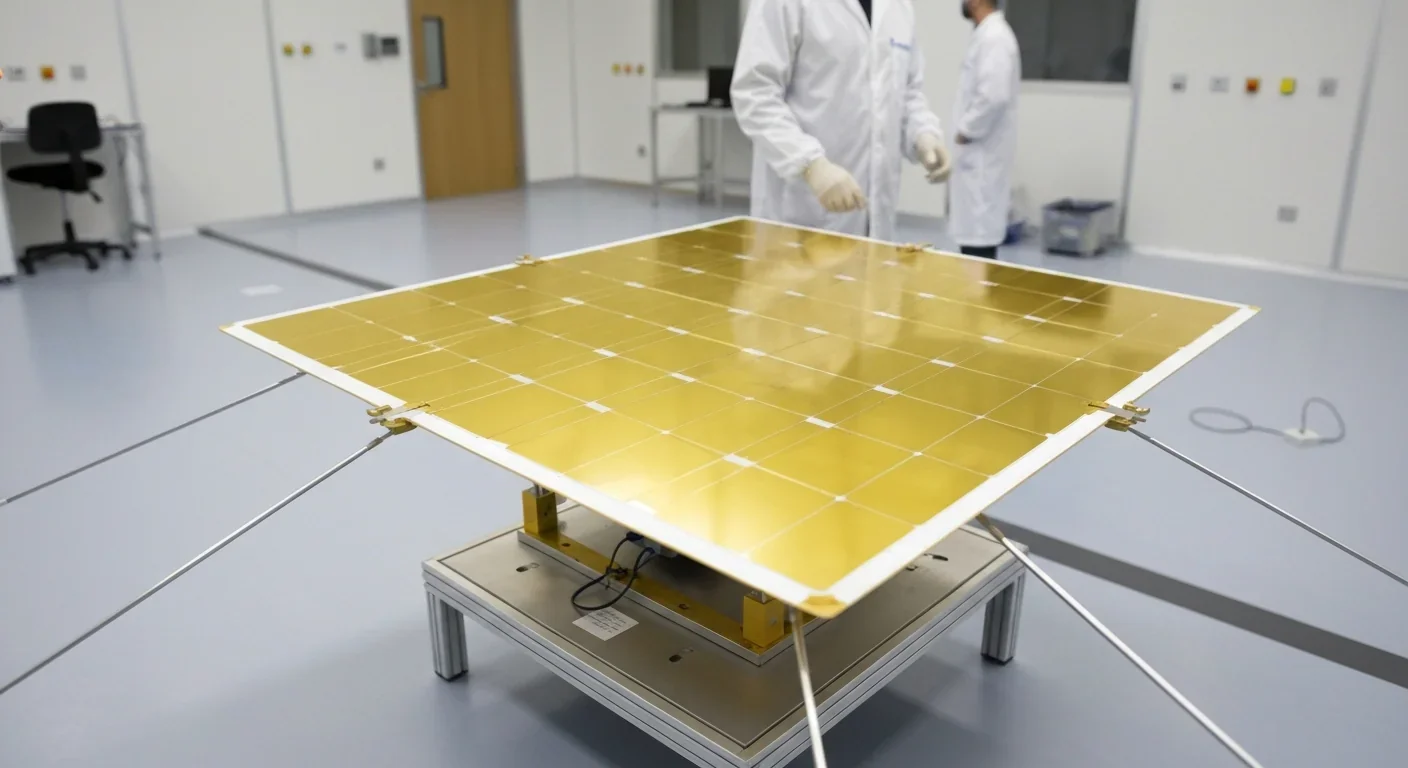
LightSail 2, funded by roughly 40,000 individual donors through the Planetary Society at a cost of just $7 million, launched in 2019 and became the first spacecraft to raise its orbit using sunlight alone. Its 32-square-meter sail increased orbital altitude by up to 1.8 km through precise orientation adjustments. The spacecraft used a reaction wheel oriented by Earth's magnetic field for fuel-free attitude control, though it spent significant time tumbling between stable orientations. As the Planetary Society described, by "tacking in and out of the Sun, it can control the force on its sail."
NEA Scout was designed to push solar sailing further. This 6U CubeSat carried an 85-square-meter aluminized polyimide sail meant to chase a near-Earth asteroid using three separate attitude control systems: reaction wheels, cold-gas thrusters, and an adjustable mass translator. It launched aboard Artemis I in November 2022 but was declared lost after the sail failed to deploy and no contact was ever established. The failure underscored a hard truth: deploying a functional sail in the vacuum of space remains one of the field's greatest engineering challenges.
NASA's Advanced Composite Solar Sail System (ACS3) demonstrated next-generation technology. Its 80-square-meter sail deployed from a 12U CubeSat using composite booms where seven meters of material rolls up into a hand-sized package. The technology could eventually scale to sails as large as 2,000 square meters, about half a soccer field, potentially enabling practical interplanetary tacking missions with meaningful thrust.
Controlling a solar sail's orientation is nothing like steering a conventional spacecraft. Attitude control has been formally identified as one of the primary disadvantages of solar sail propulsion in peer-reviewed literature, and the challenge involves keeping a structure that might span a basketball court pointed at precisely the right angle for months on end.
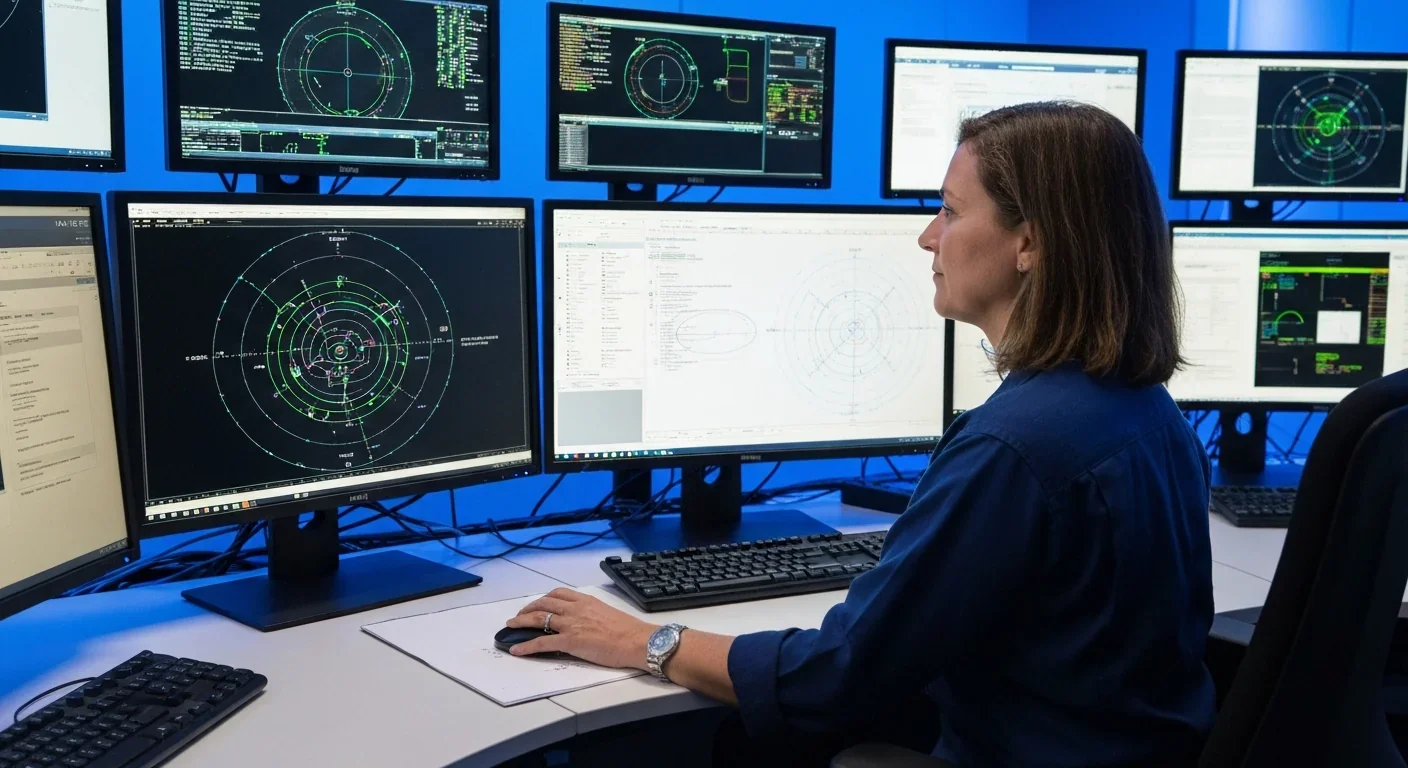
Engineers have developed several ingenious approaches. IKAROS pioneered reflectivity modulation using polymer-dispersed liquid crystal (PDLC) panels that switch between reflective and transparent states via applied voltage. Articulated reflective vanes mounted at boom tips alter the distribution of radiation pressure to generate three-axis control torques. NASA's Solar Cruiser uses an Active Mass Translator that physically shifts spacecraft mass to change the relationship between center of pressure and center of mass, the dominant variable in sail stability. If the center of mass sits between the Sun and the center of pressure, the sail is inherently stable. Shift it the other way and you get a runaway tumble.
The problem compounds over time. Reaction wheels gradually accumulate stored angular momentum during solar sail operations until they saturate and lose control authority entirely, requiring Reflectivity Control Devices or other methods to dump that stored momentum without burning propellant. As one research team concluded, "to truly take advantage of the potential of solar sails for fuel-free deep-space exploration, more creative momentum management solutions are required."
"To truly take advantage of the potential of solar sails for fuel-free deep-space exploration, more creative momentum management solutions are required."
- Solar Sail Momentum Management research team, 2025
Solar sails aren't a magic bullet. Material degradation in space gradually changes the sail's optical properties, which means the thrust vector produced at any given orientation drifts over time. Long missions need adaptive control models that account for aging. Thermal cycling from repeated tacking maneuvers, heating when facing the sun and cooling when tilted away, stresses the sail structure and its supporting booms.
The biggest design constraint remains the area-to-mass ratio. This single parameter determines how much acceleration a sail generates. Making sails larger while keeping them lightweight enough to fold into a launcher is why boom technology has been the critical bottleneck, not the sail material itself. NASA's composite booms represent a significant step forward, but scaling to the thousand-square-meter sails needed for ambitious missions remains an open challenge.
Diffractive solar sails could solve the fundamental tradeoff of reflective designs: tilting to steer currently reduces the sunlight captured. Diffractive gratings redirect light even when facing the Sun directly, enabling maximum power and steering simultaneously.
A promising solution is emerging: diffractive solar sails. Traditional reflective sails suffer a fundamental tradeoff during tacking. Tilting the sail to steer simultaneously reduces the total sunlight intercepted. Diffractive gratings can redirect light even when the sail directly faces the Sun, allowing maximum power collection and steering simultaneously, with optoelectronic control replacing heavy mechanical systems.
Solar sails are already enabling something conventional propulsion simply cannot: non-Keplerian orbits. By continuously adjusting sail angle, spacecraft can hover over Earth's poles or station themselves closer to the Sun than any gravitational balance point allows, positions ideal for early-warning solar weather monitoring that could protect power grids and satellites from coronal mass ejections. These are orbits that would be physically impossible for any spacecraft carrying a finite fuel supply.
Then there's the interstellar vision. Breakthrough Starshot proposed accelerating gram-scale light sails to 15 to 20 percent the speed of light using ground-based lasers, reaching Alpha Centauri in 20 to 30 years. Though the project has faced significant setbacks, the core physics holds. Researchers have even proposed using photogravitational assists at the destination star to brake into orbit, turning photon pressure from a one-directional push into a navigational tool for arrival.
As NASA engineer Alan Rhodes put it, "The Sun will continue burning for billions of years, so we have a limitless source of propulsion." Four centuries after Kepler imagined ships catching heavenly breezes, we're building them. The sails are thin, the thrust is small, and the patience required is enormous. But the fuel tank is the entire Sun, and it isn't running out anytime soon.
Project Orion was a real 1960s program to reach other stars by detonating 800 nuclear bombs behind a spacecraft. The physics worked and the engineering was feasible, but the 1963 nuclear test ban treaty killed it. It remains the most credible interstellar spacecraft ever designed.

The locus coeruleus, a tiny brainstem structure, degenerates decades before Alzheimer's symptoms appear. Its loss cripples the brain's inflammation control, waste clearance, and sleep regulation. New imaging tools and noradrenergic therapies offer hope for early detection and prevention.
Research shows the sharing economy often increases total resource consumption through the Jevons paradox and rebound effects. Ride-sharing adds billions of vehicle miles, co-working spaces use more energy per worker, and diffused responsibility erodes conservation behavior. Breaking the paradox requires congestion pricing, accountability design, and matching sharing models to appropriate resource types.

Psychological reactance theory explains why banning or restricting things makes people want them more. From Prohibition to the Streisand effect to scarcity marketing, research shows that threatening people's freedom reliably backfires, and autonomy-supportive communication is far more effective.

A carnivorous pitcher plant in Borneo evolved to house bats instead of trapping insects, gaining up to 95% of its nitrogen from bat guano. The plant even built an ultrasonic reflector to help bats find it, revealing that carnivory in plants is a flexible spectrum.

The quantified self movement began as a hacker-ethos pursuit of personal insight, but corporate wearables now funnel biometric data to employers, insurers, and data brokers. With 81% of Americans wrongly believing health apps are HIPAA-protected, a regulatory void enables health data to be sold for pennies while generating anxiety instead of empowerment.

CXL memory pooling lets servers dynamically share DRAM over a cache-coherent interconnect, eliminating the 40% stranded memory waste in data centers. With commercial hardware now shipping and Azure deploying CXL cloud instances, this technology promises to cut memory costs by 50% while enabling composable infrastructure.

Loading featured articles...