Project Orion: Nuclear Bomb Starship That Almost Was
Project Orion: Nuclear Bomb Starship That Almost Was
Europa Clipper Radiation Vault: Surviving Jupiter
VASIMR Plasma Engine: Could It Transform Mars Travel?
Iapetus Equatorial Ridge: The Solar System's Strangest Mountain

Titan's Hidden Ocean: Ammonia Keeps Water Liquid
Mimas: How Saturn's Death Star Moon Hides an Ocean
TL;DR: Pulsed plasma thrusters, the first electric propulsion flown in space in 1964, are making a comeback as CubeSats and microsatellites need lightweight, precise propulsion. By ablating Teflon into plasma with microsecond electrical pulses, PPTs deliver surgical pointing control that no other simple thruster can match.
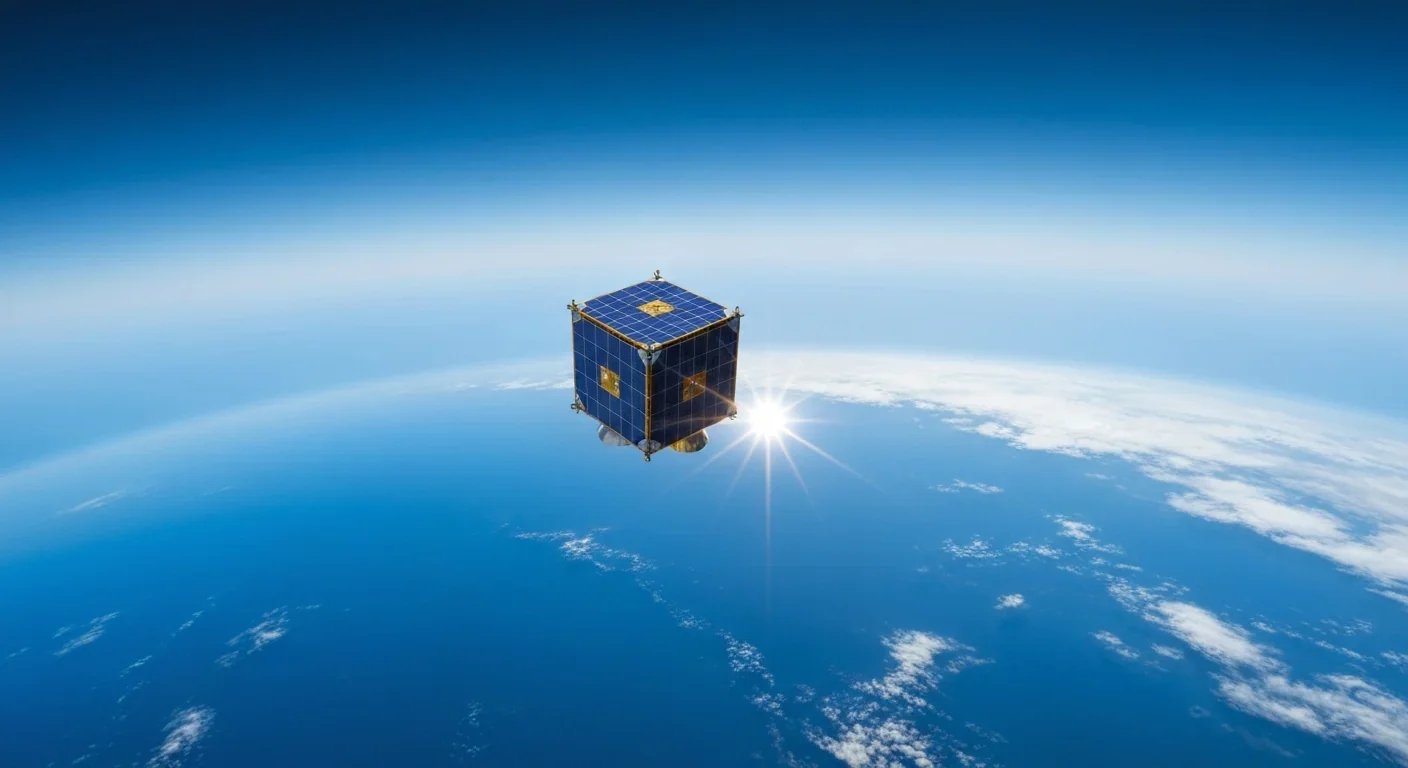
The next revolution in space won't come from bigger rockets. It'll come from something small enough to fit in a shoebox, powered by a sliver of Teflon and a spark that lasts less time than a camera flash. Pulsed plasma thrusters, first fired in space more than six decades ago, are quietly becoming the propulsion system of choice for a new generation of miniature spacecraft that need to move with the precision of a surgeon's hand. And the timing couldn't be better, because the small satellite industry is booming, and most of these spacecraft still can't steer themselves properly.
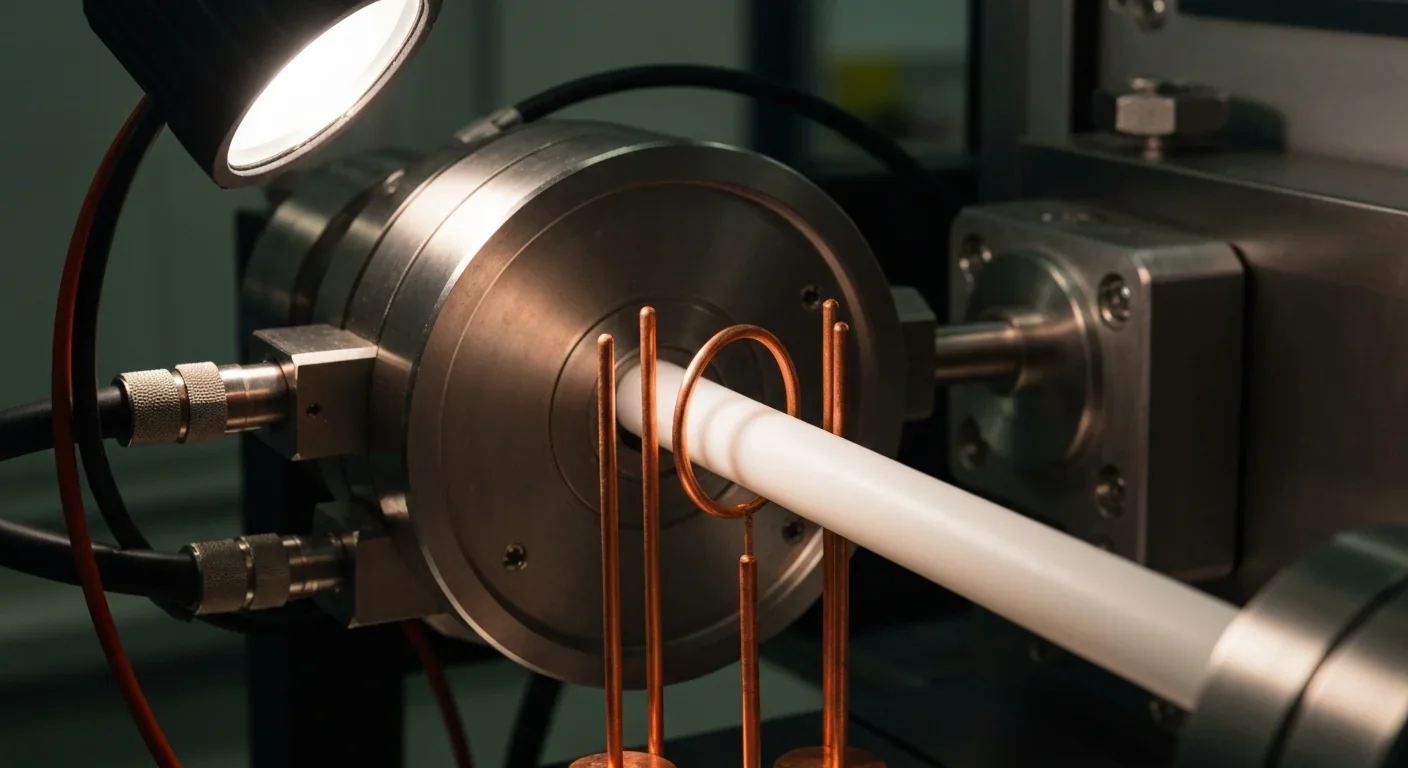
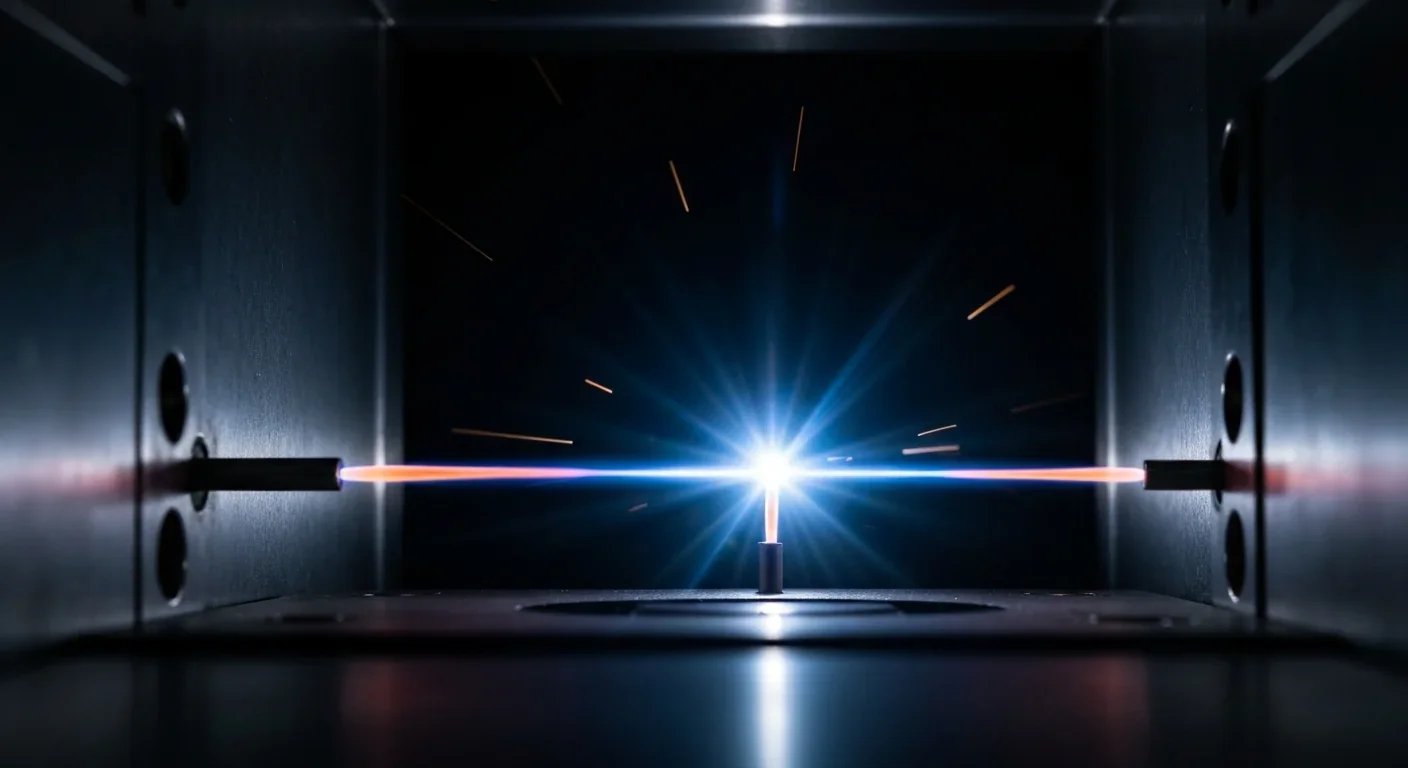
Here's how a pulsed plasma thruster actually works, and it's surprisingly elegant. Picture two electrodes sitting on either side of a solid bar of Teflon, the same nonstick material coating your frying pan. A capacitor bank, charged to somewhere between 1,500 and 2,500 volts, dumps its energy across those electrodes in a single violent pulse. That discharge vaporizes a tiny amount of the Teflon surface, just micrograms per shot, turning it instantly into superheated plasma.
What happens next is pure physics. The massive discharge current, peaking between 2,000 and 15,000 amps, creates its own magnetic field. That field interacts with the current flowing through the plasma to produce what physicists call the Lorentz force, a J-cross-B interaction that accelerates the plasma out of the thruster at tremendous speed. The whole event takes between 5 and 20 microseconds. Then the capacitor recharges, the spring-loaded Teflon bar advances slightly to replace the ablated material, and the system is ready to fire again.
Each PPT pulse ablates just micrograms of Teflon and lasts 5 to 20 microseconds, yet the plasma exits at exhaust velocities reaching 20 km/s, roughly five times faster than the exhaust of a chemical rocket engine.
The thrust from a single pulse is incredibly small, measured in micronewtons. But that's exactly the point. Each pulse delivers a precise, repeatable impulse bit, the smallest controllable nudge any thruster can give a spacecraft. For pointing a camera at a specific star, maintaining formation with another satellite, or slowly adjusting an orbit over months, that microsurgical control is worth more than raw power.
The story of pulsed plasma thrusters starts in 1964, at the height of the Cold War space race. The Soviet Union's Zond-2 probe, bound for Mars, carried six PPTs as attitude control actuators. On December 14th of that year, the system fired continuously for 70 minutes while the spacecraft was 4.2 million kilometers from Earth. It was the first electric propulsion system ever operated in space, beating every other concept, including ion engines and Hall thrusters, to the punch.
The technology developed steadily through the following decades. The U.S. Air Force and NASA invested in solid-propellant PPTs through the 1960s and 1970s, culminating in one of the most impressive demonstrations of the technology: the Lincoln Experimental Satellites LES-8 and LES-9, launched in 1978. These military communications satellites carried PPT systems operating at 25 to 50 watts that fired over 1.5 million pulses, providing north-south station-keeping and attitude control across a remarkable 14-year operational life.
Then came NASA's Earth Observing-1 (EO-1) mission in 2000, which carried a research PPT that achieved an exhaust velocity of 13,700 meters per second while consuming just 70 watts of power. The mission proved something important: PPTs could operate aboard a science satellite without generating electromagnetic interference that disrupted sensitive instruments. That finding would become crucial decades later when engineers started strapping these thrusters onto CubeSats packed with delicate electronics.
But after EO-1, PPT development largely went quiet. Bigger satellites preferred higher-thrust options like Hall thrusters and ion engines. The technology that had pioneered electric propulsion in space seemed destined for the history books.
What brought pulsed plasma thrusters back from the margins was a shift that nobody in the 1960s could have predicted: the small satellite explosion. Over the past decade, thousands of CubeSats and microsatellites under 100 kilograms have launched into orbit. These tiny spacecraft are cheap to build and launch, but they share a common weakness. Most of them have no propulsion at all.
That's a problem. Without propulsion, a CubeSat can't maintain its orbit against atmospheric drag in low Earth orbit. It can't dodge debris. It can't adjust its pointing with the precision needed for high-resolution Earth observation or laser communications. And it certainly can't participate in constellation station-keeping or formation flying, two capabilities that are becoming essential as satellite networks grow more sophisticated.
PPTs solve these problems with an almost absurd level of simplicity. The entire propulsion system consists of a capacitor bank, two electrodes, and a solid Teflon bar. No pressurized tanks. No valves. No toxic propellants. No complex plumbing. The propellant is literally a block of plastic that sits inert until you zap it with electricity. For a CubeSat engineer working within a mass budget measured in grams and a power budget measured in watts, that simplicity is transformative.
"PPTs are the only electromagnetic thrusters used on operational satellites."
- Wikipedia, Spacecraft Electric Propulsion
The specific impulse of a typical PPT, around 1,000 seconds, dwarfs what cold gas thrusters can achieve at roughly 60 to 80 seconds. That means a PPT squeezes dramatically more velocity change from each gram of propellant. And because the thrust comes in discrete, microsecond pulses, the pointing precision far exceeds what you get from a continuous-thrust system that's either on or off.
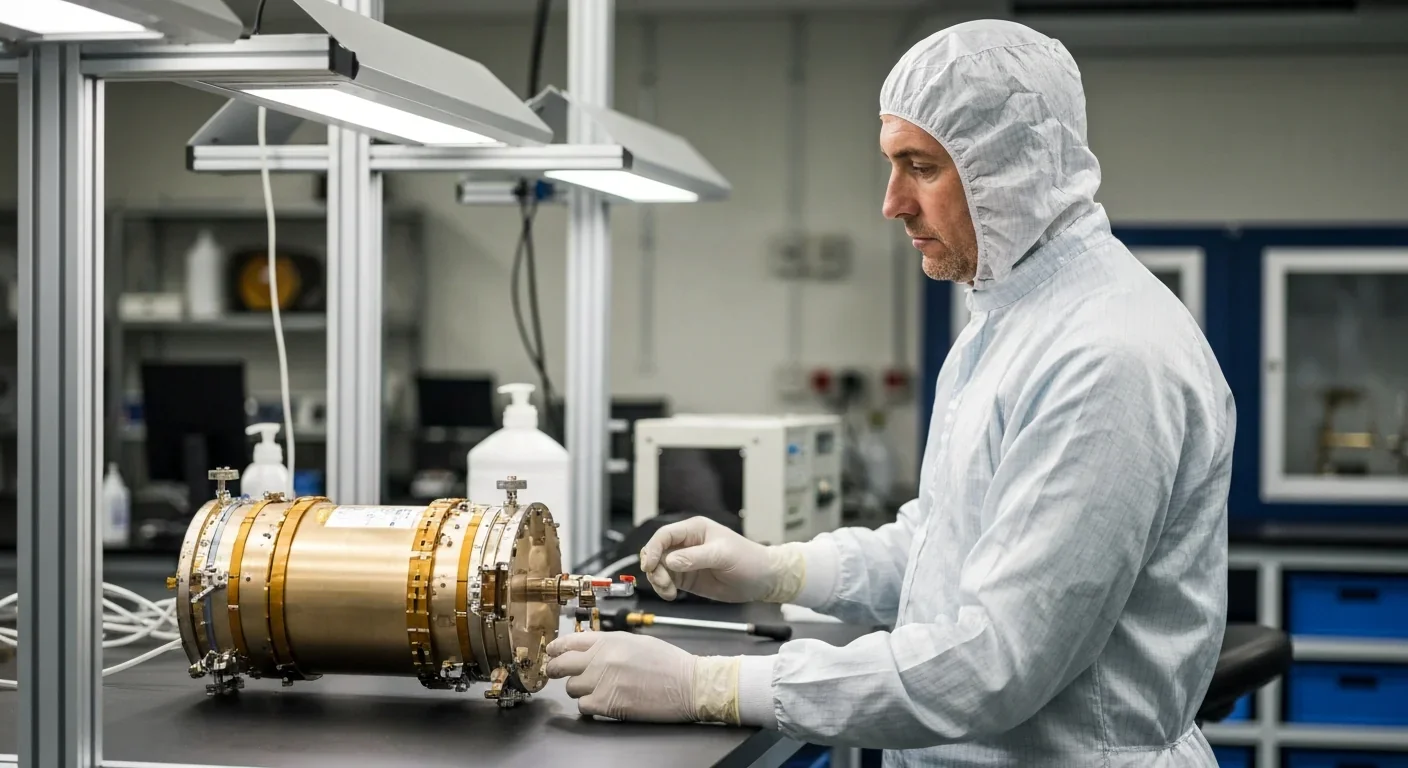
Pulsed plasma thrusters aren't the only option for small satellite propulsion, and understanding where they excel requires honest comparison with the alternatives.
Cold gas thrusters are the simplest competitors. They store pressurized gas and release it through a nozzle. They're reliable and well-understood, but their specific impulse tops out around 80 seconds, meaning they burn through propellant fast. They also need pressurized tanks, which add mass, complexity, and safety concerns for ride-share launches.
Electrospray or colloid thrusters represent the high-end competition. Busek's BET-300-P thruster achieves specific impulses of 850 to 2,300 seconds depending on configuration, and electrospray systems logged roughly 1,400 hours on the LISA Pathfinder mission, meeting 100% of mission goals. These are impressive numbers. But electrospray systems require ionic liquids, complex emitter arrays, and higher power budgets. They're elegant but demanding.
Resistojets heat a propellant electrically and expel it through a nozzle. They're simpler than electrosprays but still need liquid or gas propellant storage. Hall thrusters and ion engines, meanwhile, offer efficiencies of 50 to 80 percent but are generally too large and power-hungry for CubeSats under 12 units.
PPTs occupy a sweet spot. They deliver high specific impulse without pressurized tanks, run on just 1 to 150 watts, and their solid propellant is inherently safe. Their exhaust velocities reach 20 kilometers per second, compared to 2 to 4.5 kilometers per second for chemical rockets. The trade-off? Efficiency. And that's where the story gets interesting.
If PPTs have an Achilles' heel, it's efficiency. The overall system efficiency of a typical pulsed plasma thruster hovers around 5 to 15 percent. Compare that to Hall thrusters at 50 to 60 percent or ion engines at 60 to 80 percent, and the numbers look embarrassing. So what's eating all that energy?
The biggest culprit is late-time ablation. After the main discharge pulse ends, the Teflon surface remains hot enough to continue vaporizing material. This slow, thermal evaporation produces propellant that drifts away at low velocity, contributing mass loss without generating useful thrust. Research published in Frontiers in Energy Research found that discharge energy conversion efficiency actually reaches 85 to 90 percent, but the overall propellant-to-thrust conversion drops to just 3 to 7 percent because of these parasitic losses.
Electrode erosion compounds the issue. The repeated high-current arcs gradually wear away the electrode surfaces, changing the discharge geometry and degrading performance over time. Charring of the Teflon surface creates preferential paths for the discharge, leading to non-uniform erosion and inconsistent thrust.
Discharge energy conversion efficiency in PPTs reaches 85 to 90 percent, but late-time ablation and thermal losses drag overall system efficiency down to just 3 to 7 percent. Solving this gap is the single biggest engineering challenge in modern PPT development.
But here's why the efficiency number is misleading for CubeSat applications. These spacecraft operate on power budgets of a few watts. They're not trying to move quickly; they're trying to move precisely. A PPT running at 1 watt can still deliver meaningful impulse bits for attitude control over months or years. The fuel is light, the system is simple, and the precision is unmatched. For many missions, those advantages matter more than thermodynamic elegance.
Researchers around the world are working on solutions to PPT limitations, and some results are striking. CU Aerospace developed a Fiber-Fed Pulsed Plasma Thruster (FPPT) that achieves a specific impulse above 3,500 seconds, more than triple the typical PPT value. Their DUPLEX 6-unit CubeSat, carrying the FPPT alongside a micro-resistojet system, launched and deployed from the International Space Station for a two-year demonstration mission in low Earth orbit.
Research into capacitor optimization shows that increasing capacitance while keeping total discharge energy constant improves both impulse bit and specific impulse. Experiments found that raising capacitance from 3 to 12 microfarads boosted the impulse bit from 84.56 to 589.46 micronewton-seconds and increased specific impulse from 459 to 628 seconds. The fraction of propellant ionized by the Lorentz force jumped from 2.91 to 7.81 percent.
Alternative configurations are also gaining traction. Micro Z-pinch PPTs use tighter magnetic confinement than conventional parallel-plate designs, potentially reducing late-time ablation and improving energy conversion. Gas-fed variants have achieved specific impulses up to 13,000 seconds and thrust-to-power ratios of 80 micronewtons per watt, while emerging liquid-fed designs operate below 100 volts, dramatically reducing electrode erosion.
"Increasing capacitance to heighten the initial energy of the system under the same voltage can effectively increase the impulse generated by Lorentz force and its proportion in the impulse bit."
- Frontiers in Energy Research, PPT Energy Supply Study
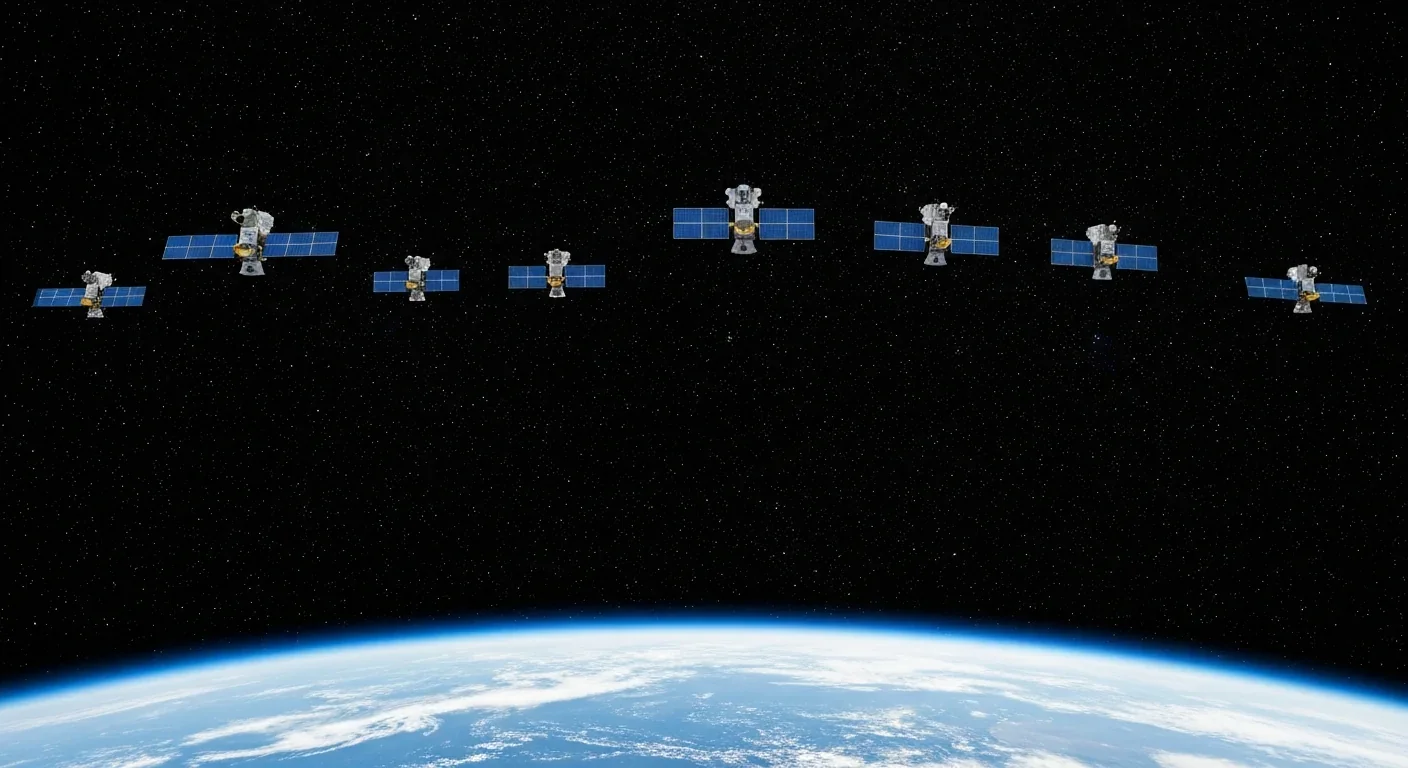
The convergence of several trends suggests that pulsed plasma thrusters are headed for a much larger role in space. Mega-constellations like Starlink have proven that satellite networks work, but future constellations will need cheaper, simpler propulsion for station-keeping. PPTs, with their solid propellant and minimal hardware, could be manufactured at scale for a fraction of what more complex systems cost.
Formation flying, where multiple small satellites maintain precise relative positions to act as a single large instrument, requires exactly the kind of fine impulse control that PPTs provide. Deep-space CubeSat missions, already being planned by NASA and ESA, need propulsion that can operate for years on minimal power. And because PPTs are the only electromagnetic thrusters ever used on operational satellites, they carry a credibility that newer technologies still have to earn.
The technology that the Soviet Union strapped onto a Mars probe in 1964, six small thrusters controlled by analog electronics, is being reborn in the age of software-defined satellites and 3D-printed spacecraft. It's a reminder that sometimes the best solution to a cutting-edge problem is a concept that's been waiting patiently in the engineering toolbox for sixty years. The small satellite revolution didn't need a new kind of engine. It just needed to rediscover the right one.
Project Orion was a real 1960s program to reach other stars by detonating 800 nuclear bombs behind a spacecraft. The physics worked and the engineering was feasible, but the 1963 nuclear test ban treaty killed it. It remains the most credible interstellar spacecraft ever designed.

The locus coeruleus, a tiny brainstem structure, degenerates decades before Alzheimer's symptoms appear. Its loss cripples the brain's inflammation control, waste clearance, and sleep regulation. New imaging tools and noradrenergic therapies offer hope for early detection and prevention.

Research shows the sharing economy often increases total resource consumption through the Jevons paradox and rebound effects. Ride-sharing adds billions of vehicle miles, co-working spaces use more energy per worker, and diffused responsibility erodes conservation behavior. Breaking the paradox requires congestion pricing, accountability design, and matching sharing models to appropriate resource types.

Psychological reactance theory explains why banning or restricting things makes people want them more. From Prohibition to the Streisand effect to scarcity marketing, research shows that threatening people's freedom reliably backfires, and autonomy-supportive communication is far more effective.

A carnivorous pitcher plant in Borneo evolved to house bats instead of trapping insects, gaining up to 95% of its nitrogen from bat guano. The plant even built an ultrasonic reflector to help bats find it, revealing that carnivory in plants is a flexible spectrum.

The quantified self movement began as a hacker-ethos pursuit of personal insight, but corporate wearables now funnel biometric data to employers, insurers, and data brokers. With 81% of Americans wrongly believing health apps are HIPAA-protected, a regulatory void enables health data to be sold for pennies while generating anxiety instead of empowerment.

CXL memory pooling lets servers dynamically share DRAM over a cache-coherent interconnect, eliminating the 40% stranded memory waste in data centers. With commercial hardware now shipping and Azure deploying CXL cloud instances, this technology promises to cut memory costs by 50% while enabling composable infrastructure.

Loading featured articles...