Project Orion: Nuclear Bomb Starship That Almost Was
Project Orion: Nuclear Bomb Starship That Almost Was
Europa Clipper Radiation Vault: Surviving Jupiter
VASIMR Plasma Engine: Could It Transform Mars Travel?
Titan's Hidden Ocean: Ammonia Keeps Water Liquid

Mimas: How Saturn's Death Star Moon Hides an Ocean
How Solar Sails Tack on Sunlight Like Ocean Ships
TL;DR: Saturn's moon Iapetus has a 1,300 km long, 20 km high mountain ridge running precisely along its equator, discovered by Cassini in 2004. No other moon has anything like it, and scientists still debate whether it formed from a collapsed ring system, rapid spin-down, or internal geology.
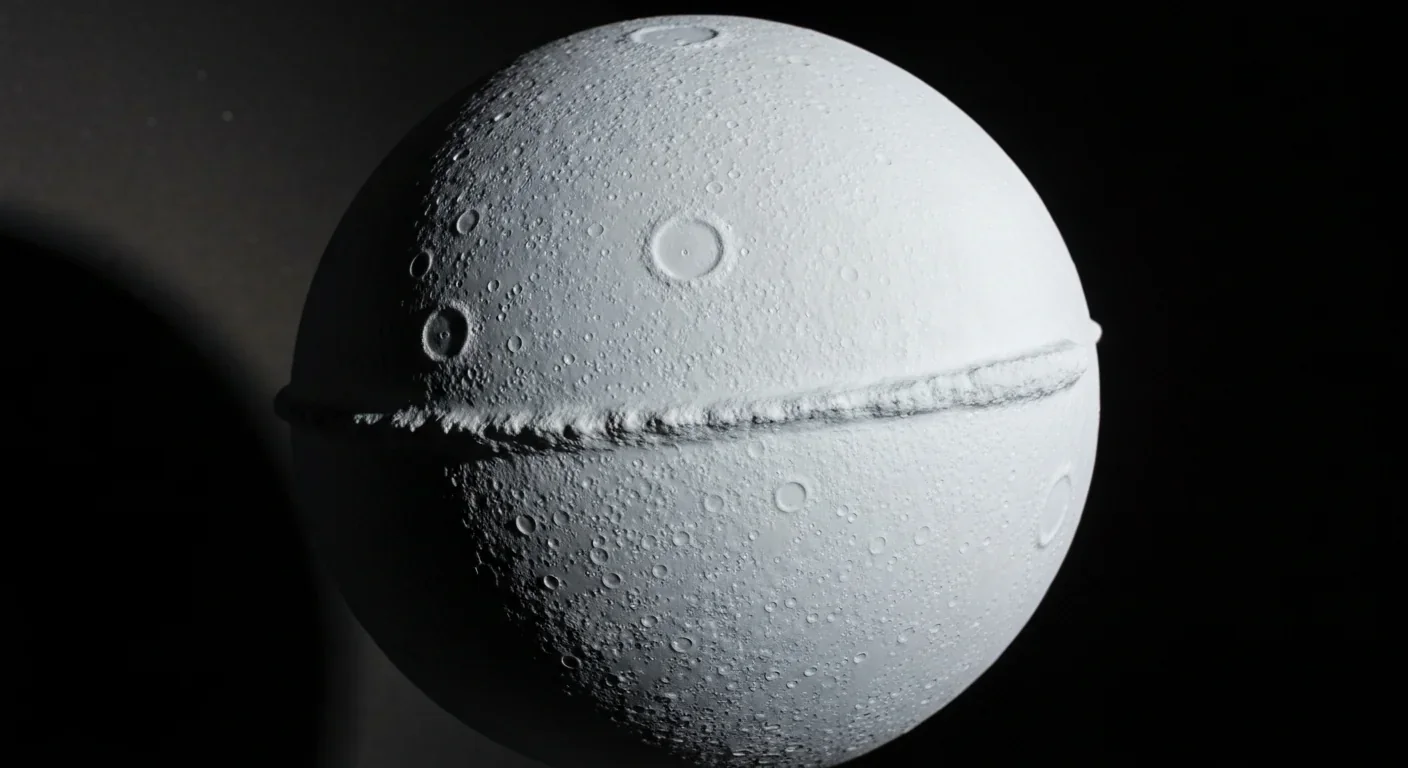
Imagine a world so small you could drive across it in a single day, yet it sports a mountain range that dwarfs anything on Earth. Saturn's moon Iapetus, barely 1,470 km across, carries a wall of peaks stretching 1,300 km along its equator and soaring up to 20 km high. That's more than twice the height of Mount Everest, wrapped like a belt around a body roughly 650 times smaller than our planet. Nobody knows how it got there. And after more than two decades of study, scientists still can't agree on an answer.
On December 31, 2004, NASA's Cassini spacecraft was swinging through the Saturn system when it turned its cameras toward Iapetus. The images that came back stopped researchers in their tracks. Running along the center of the moon's dark hemisphere, a region called Cassini Regio, was a towering linear feature that no one had predicted and no model had anticipated.
Earlier Voyager missions in 1980-81 had hinted at bright mountains near the boundary between Iapetus's light and dark hemispheres, but the lower resolution of those cameras couldn't resolve what was actually there.
Cassini's subsequent flybys between 2004 and 2007 progressively sharpened the picture. The closest approach came on September 10, 2007, when the spacecraft swept within 1,227 km of the surface, revealing that the ridge wasn't a single continuous wall but a complex, segmented structure. Some sections rise as imposing ramparts; others break apart into isolated peaks scattered along the equatorial line.
The ridge is also heavily cratered, just as much as the ancient terrain surrounding it, which tells scientists this feature isn't recent. It's been sitting there for billions of years, weathering the same bombardment as everything else on the surface.
The Iapetus equatorial ridge rises up to 20 km high on a moon just 1,470 km across. If Earth had a proportionally scaled ridge, it would be a mountain range three times taller than Everest running from Ecuador to Indonesia.
The numbers alone are staggering. The ridge measures approximately 1,300 km in length, 20 km in width, and 13 km in average height, with peaks reaching up to 20 km. The ridge accounts for roughly 2.7% of the moon's radius, a ratio unmatched anywhere else in the solar system. Nothing else comes close to matching this feature at this scale.

Iapetus was already one of the strangest objects in the solar system long before anyone spotted its ridge. Giovanni Cassini, the astronomer who first observed the moon in 1671, noticed something peculiar: he could only see Iapetus on one side of Saturn. The moon seemed to vanish when it was on the other side.
The reason, we now understand, is that Iapetus has one of the most extreme albedo contrasts of any body in the solar system. Its leading hemisphere, called Cassini Regio, is coated in dark material with an albedo of just 0.03 to 0.05. Its trailing hemisphere gleams bright white with albedos of 0.5 to 0.6, roughly ten times brighter.
This two-tone coloration isn't just a cosmetic curiosity. The ridge sits entirely within Cassini Regio, the dark hemisphere. Some Cassini imaging scientists have suggested that the ridge may have a causal relationship with that dark material, hinting that both features could share a common origin or process.
Iapetus is also unusual in its orbit. It circles Saturn at a distance of about 3.56 million km, far more distant than most major moons, and takes 79 Earth days to complete a single orbit. It's tidally locked, always showing the same face to Saturn, and its bulk density of just 1.09 g/cm³ means it's composed mostly of water ice. That icy composition matters because it determines how the ridge material behaves under stress, temperature changes, and gravitational forces.
The central mystery isn't just that the ridge exists, but that it sits so perfectly on the equator. The alignment is precise to within plus or minus one degree. Random geological processes simply don't produce that kind of symmetry. Whatever built this ridge was responding to forces that operate along the rotational axis of the entire moon.
"The ridge follows the moon's equator almost perfectly and is confined to Cassini Regio."
- NASA / Cassini Imaging Team
The Ring Collapse Theory. The most widely discussed explanation proposes that Iapetus once possessed its own ring system, or perhaps a small sub-satellite, that eventually broke apart and collapsed onto the equator. Ring material naturally settles along the equatorial plane of its parent body, so this hypothesis elegantly explains the alignment.
Research by Levison, Walsh, and Dones developed this model, and it gets a boost from an analogy within the Saturn system itself: two tiny moons, Atlas and Pan, also sport equatorial ridges formed by sweeping up ring particles. But there's a catch. Those moons are tiny, and their ridges are proportionally modest. Scaling this mechanism up to a body the size of Iapetus pushes the model to its limits.
The Spin-Down Hypothesis. Another compelling idea suggests that Iapetus once rotated much faster than it does today. A rapidly spinning body develops an equatorial bulge because centrifugal force pushes material outward at the equator. If the moon's interior was still warm and pliable in its early history, this bulge could have grown substantial.
Then, as tidal forces from Saturn gradually slowed Iapetus's rotation to its current 79-day period, the outer ice shell could have frozen solid while the bulge was still pronounced, locking it in place as a fossil feature. The spin-down model explains the equatorial alignment beautifully, but it struggles with the ridge's extreme height.
The Iapetus ridge appears on Wikipedia's list of unsolved problems in astronomy, alongside questions about dark matter and the nature of fast radio bursts. That's remarkable for a feature on a single small moon a billion kilometers from Earth.
Tidal Stress and Internal Geology. A third set of ideas looks inward. Tidal forces from Saturn could have generated stress patterns in Iapetus's ice shell, creating fractures that allowed subsurface material to push upward along the equator. Some researchers have proposed that ice welled up from beneath the surface through these cracks, building the ridge from the inside out.
The ridge's composition appears to be lower-density material, possibly purer ice, which is consistent with an internal source. And the ridge's steep flanks, with slopes greater than 30 degrees, suggest tectonic or gravitational shaping that goes beyond simple surface accretion.
Convective Overturn. A more exotic proposal involves convective overturn within Iapetus's icy interior. If warm ice from the moon's interior rose upward in convection cells aligned with the equator, it could have pushed surface material into a ridge. The heavy cratering on the ridge surface suggests that whatever process formed it shut down very early in the moon's history.
The ridge's age is one of its most significant features. Because it's cratered just as much as the surrounding terrain, planetary scientists conclude it formed very early in Iapetus's history, likely within the first few hundred million years after the Saturn system coalesced.
This timing places the ridge's formation in the same epoch as the most dramatic events in solar system history: the late heavy bombardment, the migration of giant planets, and the clearing of primordial debris from the outer solar system.
If the ring-collapse model is correct, it implies that transient ring systems around moons were more common in the early solar system than they are today. That has implications for understanding how moons accumulate mass and how their surfaces evolve. If the spin-down model is right, it constrains how quickly tidal despinning can occur and what conditions allow a moon's crust to freeze in a distorted configuration.
"The ridge is heavily cratered, indicating it is ancient."
- Wikipedia, Iapetus (moon)
The ridge also forces us to reconsider how we think about comparative planetary geology. No other confirmed moon has a comparable equatorial ridge at this scale. That uniqueness is itself a data point. Whatever combination of size, composition, orbital distance, and thermal history produced this feature apparently didn't occur anywhere else.
Planetary scientists across multiple continents have weighed in on the Iapetus ridge. American researchers at institutions like the Southwest Research Institute have championed the ring-collapse hypothesis, while European teams have explored tidal and convective mechanisms. Japanese researchers have contributed numerical simulations testing whether rapid rotation could produce the observed ridge geometry.
The lack of consensus isn't unusual in planetary science, but it is persistent. The Iapetus ridge appears on Wikipedia's list of unsolved problems in astronomy, sitting alongside questions about dark matter and fast radio bursts.
Part of the difficulty is data scarcity. Cassini provided extraordinary images during its flybys, but it wasn't designed specifically to study Iapetus, and it couldn't linger. The best resolution achieved was about 4.3 km per pixel during the September 2007 flyby, good enough to map the ridge's overall structure but not enough to resolve fine details of composition and internal layering.
No mission to Iapetus is currently planned. NASA's priorities in the outer solar system focus on Jupiter's moon Europa and Saturn's moon Enceladus, both of which have subsurface oceans that might harbor life. Iapetus, with its frozen surface and no obvious liquid water, ranks lower on the astrobiological priority list.
But a dedicated Iapetus mission would yield enormous returns for geology and planetary formation science. Even a flyby with modern instruments, far more capable than anything Cassini carried, could resolve the ridge's internal structure, map its composition at high resolution, and potentially distinguish between formation models.
The ridge, divided into three named ranges (Carcassonne Montes, Toledo Montes, and Tortelosa Montes), stands as both a monument and an invitation. It records, in frozen peaks and cratered walls, a story about the violent, dynamic early solar system that we still can't fully read.
Every hypothesis we've developed explains part of the evidence while struggling with the rest. The segmented structure challenges ring-collapse models that predict a continuous wall. The extreme height strains spin-down models. The equatorial precision rules out random geological processes.
Sometimes the most illuminating questions in science are the ones that refuse to be answered easily. Iapetus's equatorial ridge is one of those questions. It sits there, visible in every Cassini image, a 20 km tall challenge to our understanding of how worlds are built. Solving it won't just explain one strange feature on one small moon. It will reshape how we think about the forces that sculpted every frozen world in the outer solar system, and perhaps reveal processes we haven't even imagined yet.
Project Orion was a real 1960s program to reach other stars by detonating 800 nuclear bombs behind a spacecraft. The physics worked and the engineering was feasible, but the 1963 nuclear test ban treaty killed it. It remains the most credible interstellar spacecraft ever designed.

The locus coeruleus, a tiny brainstem structure, degenerates decades before Alzheimer's symptoms appear. Its loss cripples the brain's inflammation control, waste clearance, and sleep regulation. New imaging tools and noradrenergic therapies offer hope for early detection and prevention.

Research shows the sharing economy often increases total resource consumption through the Jevons paradox and rebound effects. Ride-sharing adds billions of vehicle miles, co-working spaces use more energy per worker, and diffused responsibility erodes conservation behavior. Breaking the paradox requires congestion pricing, accountability design, and matching sharing models to appropriate resource types.

Psychological reactance theory explains why banning or restricting things makes people want them more. From Prohibition to the Streisand effect to scarcity marketing, research shows that threatening people's freedom reliably backfires, and autonomy-supportive communication is far more effective.

A carnivorous pitcher plant in Borneo evolved to house bats instead of trapping insects, gaining up to 95% of its nitrogen from bat guano. The plant even built an ultrasonic reflector to help bats find it, revealing that carnivory in plants is a flexible spectrum.

The quantified self movement began as a hacker-ethos pursuit of personal insight, but corporate wearables now funnel biometric data to employers, insurers, and data brokers. With 81% of Americans wrongly believing health apps are HIPAA-protected, a regulatory void enables health data to be sold for pennies while generating anxiety instead of empowerment.

CXL memory pooling lets servers dynamically share DRAM over a cache-coherent interconnect, eliminating the 40% stranded memory waste in data centers. With commercial hardware now shipping and Azure deploying CXL cloud instances, this technology promises to cut memory costs by 50% while enabling composable infrastructure.

Loading featured articles...